
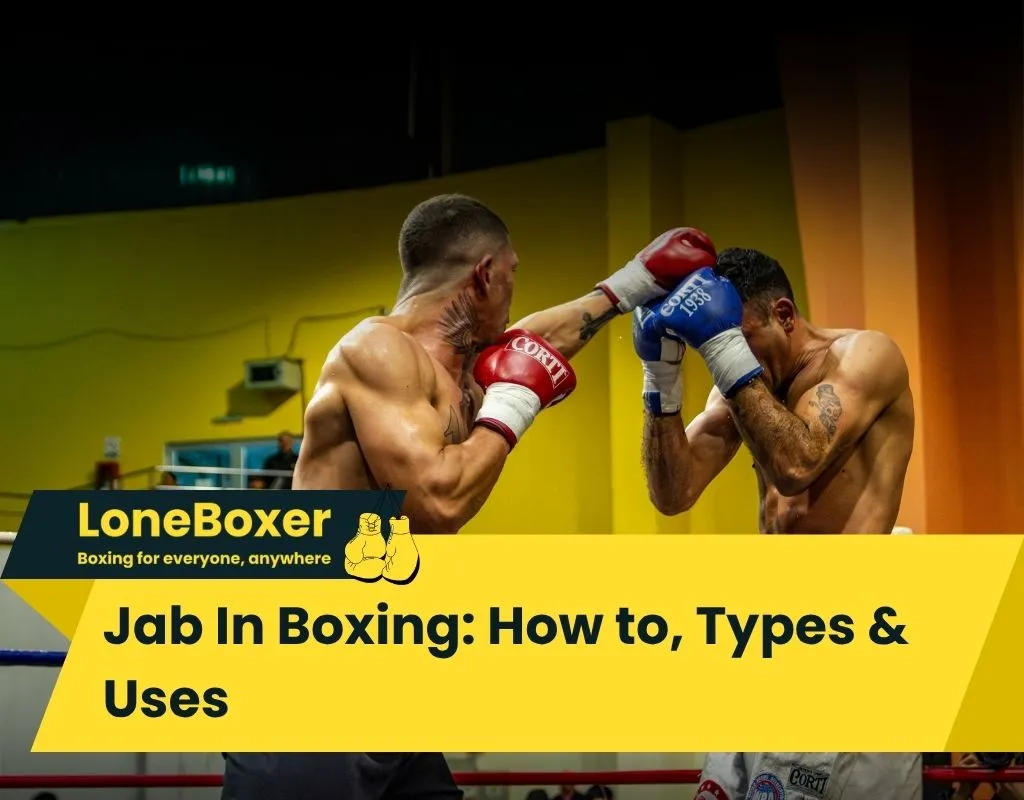
In boxing, the jab is a foundational punch, serving as a tool for range-finding, defense, and setting up combinations. It’s vital for maintaining distance, creating openings in opponents’ defense, and can be used for feints as a method of deception. While often used for its speed and reach, a well-executed jab can also deliver knockout power. There are various types of jabs, including the step jab, backstep jab, pivot jab, upward jab, and power jab, each with unique applications like closing distance, creating space, altering attack angles, and feinting. Mastery of jabbing techniques through practice is crucial for a boxer’s defensive and offensive strategies, and to utilize other types of punches, such as the cross.
- How to Throw The Basic Jab?
- What are the Types of Jabs?
How to Throw The Basic Jab?
- Boxers assume a stance with the dominant foot back, creating a stable base, and raise their guard, positioning their hands by their face to protect against incoming blows. Feet are shoulder-width apart for balance, and the body’s weight is distributed evenly or slightly on the front foot for quick movement.
- To throw a jab, a fighter snaps the lead hand forward straight from the guard position, aiming to hit the target with the first two knuckles. While the punch is in motion, turn the fist to land with the palm facing down. The arm fully extends while the opposite hand remains guarding the face.
- After releasing a jab, it’s crucial to retract the hand swiftly to the guard position to defend against counterattacks. Even when executing multiple jabs, each punch retracts before the next, maintaining a defensive posture between strikes.
- Proper breathing involves exhaling sharply upon jab extension. This technique aids in power delivery, endurance, and rhythm maintenance, ensuring the boxer remains relaxed and can throw successive punches effectively.
Mastery of the jab requires diverse practice methods, including shadowboxing, mitt work, and heavy bag drills. These exercises enhance precision, speed, and endurance; hence, they’re integral to a boxer’s training regimen.
What are the Types of Jabs?
- Straight Jab: The bread-and-butter of boxing, the straight jab is a fundamental punch thrown directly from the lead hand, serving to gauge distance, set up combinations, and control the pace of the fight.
- Flicker Jab: Renowned for its speed and precision, the flicker jab is a lightning-quick punch aimed at disrupting the opponent’s rhythm and keeping them at bay, often used by fighters with exceptional hand speed and timing.
- Power Jab: Utilized to assert dominance and inflict damage, the power jab is thrown with maximum force and intention, often serving as a tool to deter opponents and set up more powerful punches.
- Up-Jab: Employed to change angles and disrupt the opponent’s guard, the up-jab is directed upwards towards the opponent’s face, aiming to surprise them and create openings for follow-up attacks.
- Feint Jab: Masterfully deceptive, the feint jab is thrown with the intention of tricking the opponent into reacting, exploiting their responses to create opportunities for counters or to set up more significant strikes.
- Double Jab: Doubling up on the jab adds unpredictability and pressure, overwhelming opponents with a rapid succession of two jabs, often used to maintain control of the center of the ring or to create openings for power punches.
- Body Jab: Targeting the opponent’s midsection, the body jab is used to weaken their core, sap their energy, and set up future body shots or head punches by forcing them to drop their guard or adjust their stance.
- Counter Jab: Sharp and precise, the counter jab is thrown in response to the opponent’s attack, exploiting openings in their offense to intercept with swift and accurate retaliation, often disrupting their momentum and regaining control of the bout.
Variations of jab include “tapping” to gauge distance, “double jab” for increased pressure, and “counter jab” to exploit the opponent’s openings. Mastery of jabbing while moving is crucial for maintaining offensive and defensive capabilities in the ring.
Is Jab Right or Left Hand Punch?
A jab is typically thrown with the lead hand, which is the left hand for an orthodox stance and the right hand for a southpaw stance. The cross, also known as a straight, is executed with the rear hand, opposite the jabbing hand. Thus, for an orthodox fighter, the cross is a right-hand punch, while for a southpaw, it’s a left-hand punch. However, the jab is quicker, used for range finding and setting up other punches, whereas the cross is more powerful, intended as a follow-up or counter-strike. Hence, the main difference between a jab and a straight lies in the hand used and the punch’s purpose.
What are The Common Mistakes With the Jab?
Boxers often telegraph the jab, signaling their intent through unnecessary movements. Typically, it is caused by high stress, adrenaline, or poor strategy. To avoid this, fighters should vary the jab’s speed and angles to keep the behavioural patterns unpredictable for the opponent. Dropping the hand or not returning the hand to defensive position after the jab is another mistake, leaving the fighter vulnerable to counterattacks. This is usually due to poor training and should be practiced regularly with correct technique during training. Overextending the jab can also occur, compromising the balance of the fighter and risking shoulder injury. Typically, overextending is caused by reaching for the opponent rather than stepping in.
How to Perfect the Jab?
A perfect jab is swift, accurate, and thrown with minimal telegraphing. To hone this punch, one must engage in various drills that enhance speed, precision, and technique.
Shadowboxing sharpens coordination; envision an opponent, throw jabs with full extension, and rotate the fist at the end. Focus on footwork, ensuring a balanced stance as the jab lands. Visualizing successful jabs and anticipating different scenarios during training can improve decision-making and reaction time in real fights.
Mitt drills with a coach refine timing and accuracy. The coach presents targets, simulating a moving adversary. The boxer snaps jabs towards the mitts, retracting the hand quickly to guard.
Heavy bag work builds power and endurance. Execute jabs in rapid succession, maintaining form. The bag’s resistance aids in developing muscular strength.
Partner drills foster defensive skills. Boxers exchange jabs, practicing head movement and footwork to dodge and counter.
Incorporate these exercises consistently, and the jab’s effectiveness will surge.
How to Increase The Power of a Jab?
To augment jab power, engage the entire body, not just the arm. Initiate the motion from the legs, driving force upward through pivoting of the lead foot, rotating the hips, and extending the shoulder. This kinetic chain maximizes force transfer. Strengthening specific muscle groups involved in the jab is also important. Exercises such as plyometrics, medicine ball throws, and resistance training targeting the shoulders, core, and legs can improve explosiveness and endurance, contributing to increased jab power over time.
A drill to enhance jab power is the step jab: from a boxing stance, step forward with the lead foot simultaneously with the jab. This movement adds body weight to the punch, increasing the power of the impact.
Speed boosts power; a faster jab carries more kinetic energy. However, speed without proper technique reduces effectiveness. Thus, precision in the kinetic chain is crucial for a potent jab.
Why is Jab the most Important Punch to Learn?
The jab is the most important punch to learn in boxing as it establishes distance control and sets up offensive and defensive maneuvers. It’s a versatile tool for gauging the opponent’s reach and for creating openings through feints.
One aspect missing here is the jab’s role in disrupting an opponent’s rhythm and timing. By consistently landing jabs, a boxer can throw off their opponent’s tempo, making it difficult for them to mount an effective offense or defense. Additionally, the jab can be used to probe an opponent’s defenses, identifying weaknesses and openings for more powerful punches later in the bout.
The basic jab is essential for maintaining range and rhythm, disrupting the opponent’s focus. The step jab amplifies this by closing distance assertively, allowing for aggressive follow-ups. Conversely, the backstep jab creates space, facilitating defensive strategies and counterattacks. The pivot jab is excellent for creating angles, making it harder for the opponent to counter. Each variation serves a strategic purpose, culminating in the power generated through precise timing and technique.
How To Set Up Combinations With the Jab?
A jab sets up combinations by establishing range. It distracts opponents, creating openings. Follow a jab with a cross to penetrate defenses. Double up the jab for unpredictability, then launch a hook. Use feints; a jab feint draws reactions, hence revealing targets. Incorporate body jabs to lower guard, then target the head. Timing is crucial; jab during an opponent’s attack to disrupt rhythm. Practice jab-to-combination drills to enhance muscle memory. Maintain balance for continuous striking. Vary jab speed and power to confuse the adversary. Always return to the defense post-combination.
How to use Jab for Feinting?
To use a jab for feinting, initiate a slight shoulder movement and partial arm extension, deceiving the opponent into anticipating a full jab. Don’t fully extend the arm; instead, quickly retract it, readying for a follow-up punch or defensive maneuver. This feint can create openings, disrupt timing, and gauge the opponent’s reactions. After a jab feint, moving laterally or pivoting can create new angles of attack, making it harder for opponents to defend against follow-up punches. Incorporating subtle shifts in position can also help create openings for additional strikes, maximizing the effectiveness of the combination.
How to Adjust Jab Against Different Opponents?
- Against Taller Opponents:
Facing a taller opponent requires caution and strategy. Shorten the extension of your jab to maintain a defensive posture while engaging effectively. By keeping your jab compact, you reduce the risk of overextending and vulnerability to counters. Use footwork to maneuver in and out of your opponent’s range, seeking opportunities to land your jab while minimizing exposure to their longer reach.
- Against Shorter Opponents:
Shorter opponents often seek to close the distance quickly to negate your reach advantage. Fully extending your jab becomes crucial to create space and keep them at bay. However, maintaining a tight defense after jabbing is equally important, as shorter fighters excel at slipping inside and capitalizing on openings. Focus on controlling the distance with your jab while remaining vigilant against aggressive advances.
- Stability Against Aggressive Fighters:
Aggressive opponents who press forward relentlessly demand a solid defensive foundation. Adopting a wider stance offers better stability and balance, allowing you to absorb their attacks while delivering effective jabs. Maintain your position in the center of the ring, using your jab to control your opponent’s movements and dictate the pace of the fight. By staying composed and leveraging stability, you can frustrate aggressive opponents and limit their effectiveness.
- Speed Against Swift Opponents:
Swift opponents require agility and rapidity to match their pace. A narrower stance facilitates quicker movements and rapid jab deployment, essential for keeping up with their speed. Utilize footwork to pivot and angle off, creating openings for your jab while remaining elusive. Leveraging your speed and agility enables you to match the fight’s tempo and capitalize on opportunities to land clean shots.
- Disrupting Southpaw Opponents:
Southpaw opponents present unique challenges due to their opposite stance. Pivot your lead foot to the outside and throw the jab across their lead hand to disrupt their defensive posture. This creates openings for follow-up attacks while minimizing their ability to counter effectively. Stay proactive and maintain pressure to prevent southpaw opponents from settling into their rhythm.
Why is Correct Jab Timing Important?
Timing remains crucial regardless of your opponent’s stature or style. Observing your opponent’s rhythm allows you to anticipate their movements and launch your jab at opportune moments. Whether timing their steps or punches, catching them off-guard enhances your jab’s effectiveness. Mastering timing and rhythm enables you to maintain control and increase your chances of success in the ring.
How to use Jab For Defence?
To use the jab for defense, employ it to maintain distance and establish a barrier against your opponent’s attacks. Utilize your jab to set the timing and rhythm of the fight, creating opportunities for counters and evasions. Additionally, use the jab to create angles and move around your opponent while staying balanced and mobile. For example, if an opponent lunges in with a right cross, a quick, stiff jab can halt their advance and reset the engagement.
How To Block and Counter a Jab?
To block a jab, raise your lead hand, keeping your elbow down, and deflect the punch. Immediately counter with a cross aiming for the opponent’s head or body. Timing’s crucial; execute the counter as your opponent’s jab retracts to exploit their temporary vulnerability in their defense.
What are Other Types of Boxing Punches?
There are four main types of punches in boxing: the jab, cross, hook, and uppercut. Beyond these basics, boxers employ variations like the overhand, bolo punch, and check hook. The overhand, a looping punch thrown over the top, targets an opponent’s head. The bolo punch, mimicking an uppercut or a hook, deceives and opens defenses. The check hook, executed while pivoting away, counters aggressive opponents. Each variation serves strategic purposes, diversifying a boxer’s arsenal.
What is the Difference Between a Jab and a Cross?
The jab is often used as a tool for maintaining distance, setting up combinations, and gauging the opponent’s reactions. On the other hand, the cross is described as a powerful punch delivered with the rear hand and is typically thrown less frequently due to its emphasis on generating force rather than speed or control.