
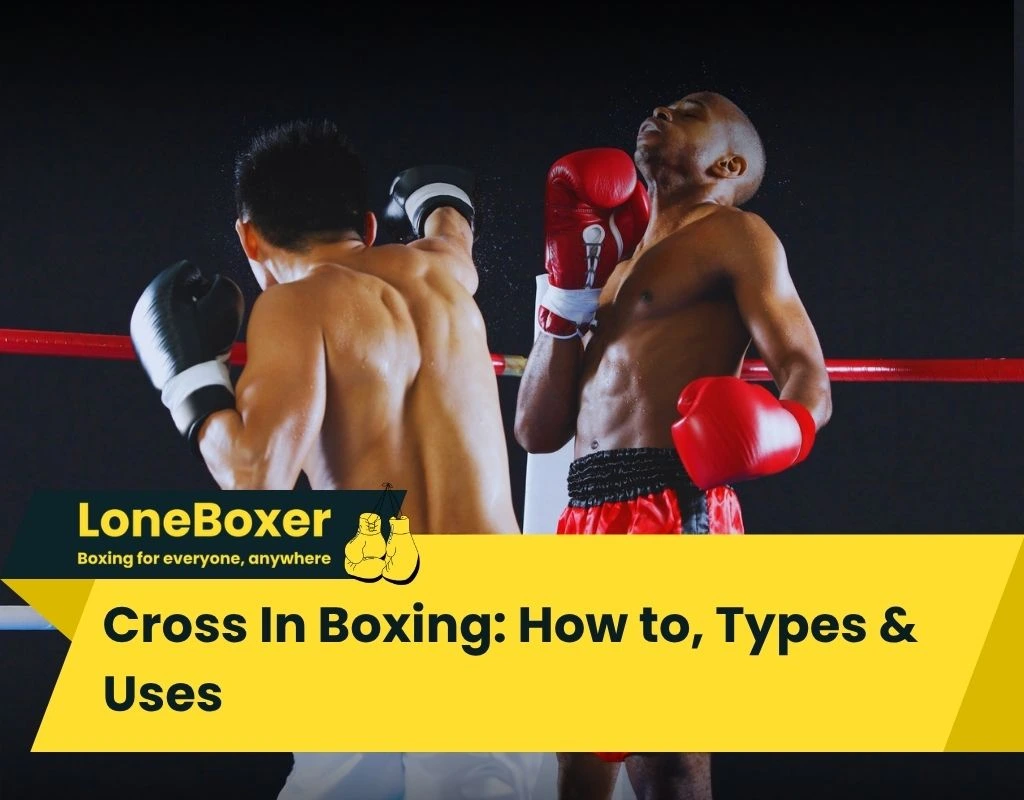
The cross (or straight) is a power punch delivered with the dominant rear hand in both orthodox and southpaw positions. To execute, the rear hand is extended from a boxing stance straight towards the target while pivoting the rear foot, and rotating the hips to amplify force. After the shot is delivered, the body is returned to the original stance, with the rear hand moved back to the guard. Practice ensures the cross becomes a reflexive, effective strike in the ring. To counter a cross, raise the rear hand to block, then exploit the opponent’s exposure with a countering punch, such as the jab, to take advantage of the opponent’s temporary vulnerability.
How to Throw A Cross?
- Assume a boxing stance, guard raised. Your feet should be shoulder-width apart, dominant hand and foot back if you’re orthodox, reverse if southpaw.
- Extend your rear hand straight toward the target, aiming with your two main knuckles. Keep your elbow in line with your fist to maximize force.
- Shift about 60% of your weight onto your lead foot as you punch. This forward weight transfer adds momentum.
- Pivot your rear foot, heel rising, about 45 degrees while turning your hips; this rotation increases the punch power of your cross.
- Twist your torso in the direction of your stance; left for orthodox, right for southpaw. This body rotation further amplifies punching power.
- Rotate your fist so your palm faces down at contact with the target. This aligns your arm bones for a solid impact.
- Snap your hand back to the guard immediately after the punch lands. This protects you from counterattacks. Be sure not to over-extend or hyper-extend your arm.
- Control your breathing; exhale sharply as you throw the cross. This stabilizes your core and maintains rhythm.
Practice consistently. Repetition builds muscle memory, ensuring your cross becomes a natural, effective reflex in the ring.
How to Perfect the Cross?
To perfect the cross constant practice of various drills with correct form is necessary, as it enhances muscle memory. To apply drilled techniques in real combat, sparring is recommended. Throughout training, film and analyze your form and seek feedback from experienced coaches or training partners if available.
To practice at home, adopt a balanced boxing stance. Rotate your rear foot counterclockwise, driving power from the ground up. Twist your hips and shoulders simultaneously, while extending your rear hand straight towards the target. Snap your punch quickly, retracting your hand to the guard position immediately. For increasing precision, align your fist, wrist, and forearm in a straight line. Keep your lead hand up at all times, protecting your face. Practice the motion slowly, focusing on form, then gradually increase speed. As you progress, visualize the cross during shadowboxing, reinforcing the technique mentally.
To increase the power of the punch, incorporate strength training into your regimen. Particularly, exercises that bolster the core and shoulders, as well as plyometrics, are a fantastic way to develop fast-twitch muscle fibers, which are crucial for explosive movements and agility.
How to Increase the Power of the Cross?
To boost the power of a cross beyond strength training, refine your technique and engage your core while punching. Proper alignment and rotation of the body should be used to amplify force. Speed training enhances power, too; a swift cross can deliver a knockout. Train with plyometrics and heavy bag drills to increase punch speed. Consistent practice with correct technique hones both speed and power.
What are the Common Mistakes with the Cross?
Common Mistakes with the Cross are often due to poor technique and timing. Common mistakes with the cross include dropping the lead hand, telegraphing the punch, incorrect footwork, and poor body alignment. To fix the most common mistakes:
- Maintain the lead hand’s guard position to protect against counterattacks.
- Minimize telegraphing.
- Align feet with shoulders for stability; pivot on the back foot and turn your hips into the punch for power.
- Reset back into your initial guarded stance by retracting the punch quickly.
Consistent practice with a focus on form corrects these errors, enhancing the cross’s effectiveness.
What are the Variations of the Cross?
Cross punches in boxing can vary slightly depending on the boxer’s style, but here are a few classic ones:
Straight Right Cross: This is the typical variation of the cross punch. The boxer extends their rear arm straight out, rotating their hips and shoulders to generate power, aiming to hit the opponent’s chin or body.
- A straight right typically goes straight forward from the boxer’s rear hand, targeting the opponent’s centerline or the inside of their jab.
- A right cross, on the other hand, involves the rear hand crossing over the middle (hence the term “cross”), often going over the opponent’s jab to land on their chin or head.
Overhand Right: This is a looping version of the cross punch where the boxer aims to come over the opponent’s guard with a downward angle. It’s effective for getting around an opponent’s defense, especially if they have a high guard.
Counter Right: This is a counter-punch where the boxer uses their lead hand (left hand for orthodox stance, right hand for southpaw stance) to parry or deflect the opponent’s punch, simultaneously countering with a cross punch from the rear hand.
Feint Cross: This is more of a setup punch. The boxer throws a feint with their lead hand to draw a reaction from the opponent’s guard, then quickly follows up with a cross punch from the rear hand to exploit any openings created by the feint.
Each boxer may have their own variations or combinations based on their style and preferences.
Is Cross Left or Right-Hand Punch?
In boxing, the cross is typically thrown with the rear hand. So, in an orthodox stance (where the boxer’s left foot is forward), the cross is a punch thrown with the right hand. Conversely, in a southpaw stance (where the boxer’s right foot is forward), the cross is thrown with the left hand.
Why is the Cross Important Punch to Learn?
The cross punch serves as a pivotal tool in boxing, facilitating the setup of intricate combinations. It’s instrumental in breaking through an opponent’s guard, often leading to potential knockouts. Boxers utilize the cross for swift countering, exploiting openings in the rival’s defense. The Cross is also a critical tool for controlling the distance and tempo of a fight. Its speed makes it challenging for adversaries to detect and evade.
How to Block and Counter the Cross?
To block the cross, a high guard can be used by raising both hands to shield your face. Fighters can also employ a parry technique to redirect the punch slightly off course. Alternatively, head movements with a slip can help evade the cross entirely.
To counter the cross, seize the moment with a swift straight counterpunch, aiming for the opponent’s exposed chin or body. Another tactic used by the fighters is stepping back to create space and launching a counter cross of their own, capitalizing on the opponent’s forward momentum.
How to Block Power Punches?
To block power punches, adopt a defensive stance; keep your hands up, and elbows tucked. When an opponent throws a cross, pivot your front foot slightly, rotate your torso, and raise your rear hand, ensuring your forearm is vertical, aligning with the incoming punch. Absorb the impact on your glove and forearm to minimize damage.
What’s Cross Block in Boxing?
In boxing, a cross block is a defensive technique used to protect against punches aimed at the head or upper body. It involves positioning one arm across the body to block incoming punches, typically with the forearm or glove covering the face and the other hand held up to guard the opposite side. The cross block provides a solid barrier against straight punches like jabs and crosses, helping to deflect or absorb the impact of the opponent’s strikes.
What are Alternative Punches to Cross in Boxing?
Alternative punches to a cross include the jab, hook, uppercut, and overhand. Different punches in boxing serve distinct strategic purposes, diversifying a boxer’s offensive arsenal. The jab, a quick, straight punch with the lead hand, sets up combinations and gauges distance. The hook, delivered with a bent arm, targets an opponent’s side or head, generating power through body rotation. The uppercut, thrown with the rear or lead hand, strikes upward, aiming for the chin or body, effective at close range. The overhand, a looping punch over the opponent’s guard, capitalizes on height or reach advantages, often surprising targets from above.
What’s the Difference Between a Cross and a Right Hook?
A cross is a straight punch thrown with the rear hand; it’s a quick and direct strike. A right hook is thrown from the side with the rear hand, generating power through the rotation of the body. Both strikes differ in mechanics and strategic use in boxing.
What’s the Difference Between Cross and Jab?
A cross is a power punch thrown with the rear hand, typically aimed at the head or body, capitalizing on reach and force. The jab is a quick, straight punch thrown with the lead hand, used to gauge distance, set up combinations, or disrupt an opponent’s rhythm.