
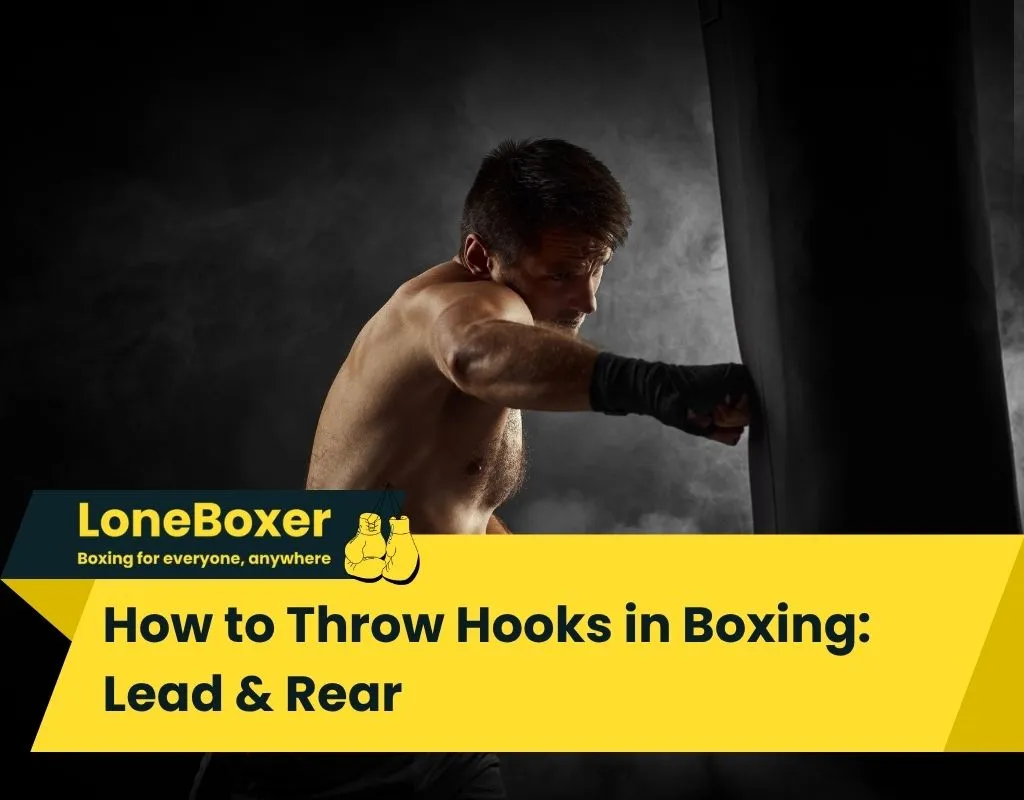
The hook in boxing is a powerful close- or medium-range punch thrown in a semi-circular motion with the lead hand or the rear hand. For orthodox fighters, the lead hook is executed with the left hand, and the rear hook is delivered with the right hand. Both variations are forceful, whereas the rear hook is more potent due to ability to leverage hip and leg torque more. While throwing hooks, it’s crucial to maintain a 90-degree angle at the elbow and make contact with the knuckles of the index and middle fingers to avoid thumb injury. For body shots, the stance is lowered by slightly bending the knees.
Hooks are versatile punches, used when an opponent’s guard drops or to counter a missed jab. They’re effective in close combat or as a feint to catch an opponent off guard. To avoid predictability, fighters mix hooks, jabs, and uppercuts, maintaining an element of surprise.
1. How to Throw a Lead Hook?
A lead hook is a powerful, short-range punch thrown with the lead hand, curving inward towards the opponent. To execute a lead hook effectively:
- Begin in a boxing stance, weight balanced, knees slightly bent.
- Keep your rear hand up to guard your face; your lead hand at chin level, elbow down.
- Pivot your lead foot, rotating your body to generate power.
- Shift weight from the back foot to the lead foot during the pivot.
- Keep the elbow bent at a 90-degree angle at shoulder height, maintaining alignment between the fist and shoulder.
- Turn your hips and shoulders swiftly with the pivot, enhancing force.
- Aim the punch at the opponent’s head or body, targeting the jaw or ribcage.
- Exhale sharply as you initiate the punch, directing the force and maximizing power.
- Retract your hand quickly after impact, returning to the guard position.
For a lead hook to the body:
- Lower your body by bending at the knees, not the waist.
- Pivot as described, targeting the opponent’s midsection.
- Keep your other hand guarding your face for protection.
The power of a hook comes from the rotation of the body, not just the arm. Practice the movement fluidly to ensure speed and precision.
2. How to Throw a Rear Hook?
A rear hook is a powerful, circular punch thrown with the backhand. It targets an opponent’s head or body, utilizing the torque generated from the hips and legs.
To throw a rear hook:
- Start in a boxing stance: feet shoulder-width apart, lead foot slightly forward, knees slightly bent.
- Keep your lead hand up to guard your face; your rear hand at chin level, elbow down.
- Shift your weight to your lead leg.
- Pivot your rear foot, turning your heel outward.
- Rotate your hips and torso towards the lead side.
- Swing your rear hand in a horizontal arc towards the target.
- Keep your elbow bent at a 90-degree angle while maintaining alignment between elbow, shoulder, and fist.
- Exhale sharply as you initiate the punch, directing the force and maximizing power.
- Retract your hand quickly after impact, returning to the guard position.
For a rear hook to the body:
- Lower your stance slightly by bending your knees further.
- Pivot and rotate, targeting the opponent’s midsection.
- Aim for the liver or ribs to maximize effectiveness.
- Keep your opposite hand guarding your face.
The rear hook’s effectiveness lies in precision and speed, not just power. Practice ensures proper form and reduces the risk of injury.
How to Perfect the Hook Punch?
To perfect the hook punch, adopt a solid stance, ensuring balance and power. Rotate your core as you pivot your lead foot, generating force. Keep your elbow bent at a right angle, aligning it with your shoulder and fist at impact. Practice shadowboxing, focusing on form and fluidity. Incorporate heavy bag workouts, striking with precision, and varying intensity. Drill with a partner using focus mitts, honing accuracy and timing. Employ slip bags to enhance reflexes and head movement. Consistency and repetition are key; thus, train regularly, analyzing and adjusting technique for improvement.
How to Practice The Hook Punch on Heavy Bag?
Stand parallel to the heavy bag, feet shoulder-width apart. Pivot your lead foot, rotating your body to generate power. Throw the hook at close range, elbow bent at a 90-degree angle, aiming for the bag’s midsection. For mid-range hooks, step slightly toward the bag, maintaining the elbow position. Extend your arm further for long-range hooks, still pivoting for force, and rotating this fist inwards to hit with the first two knuckles. Incorporate head movement and footwork, dodging imaginary counterpunches. Practice hooks in combinations, alternating hands, varying punch speed, and power.
How to Increase the Power of the Hook?
To amplify a hook’s power, pivot your lead foot and rotate your hips. Power originates from the ground up, channeling through your legs, core, and into your arm. Engage your entire body, ensuring your back foot pushes off the ground, thus transferring maximum force. Keep your elbow bent at a right angle to maintain punch integrity. The synchronized body movement is key to generating a strong punch and increasing the hook’s potency.
What are Common Mistakes With the Hook?
Some of the most common mistakes and appropriate corrections for throwing hooks are listed below.
- Dropping the elbow. Fix: Keep the elbow at shoulder level to maximize power and avoid joint injury.
- Overextending the arm. Fix: Snap the hook at a 90-degree angle, maintaining balance and preventing counterattacks.
- Neglecting body rotation. Fix: Engage the core and pivot on the lead foot to add force and reach.
- Ignoring defense. Fix: Return to guard position quickly after throwing the hook to block incoming punches.
- Poor timing. Fix: Practice the hook with a rhythm, integrating it into combinations for fluid execution.
- Excessive tension. Fix: Relax the muscles until the moment of impact to increase precision, speed, and reduce fatigue.
- Holding your breath when punching. Fix: Focus on maintaining steady breathing throughout the movement, exhaling sharply upon impact to enhance power and maintain oxygen flow.
What are the Types of Hooks?
Below are the most common hook variations:
- Shovel hook, a hybrid punch, combines an uppercut and a hook, targeting an opponent’s body or chin. It’s effective for penetrating guards.
- Double hook, a combination punch, involves two hooks in succession, usually targeting different levels such as the head and the body.
- Check hook, a defensive technique, allows a boxer to pivot away while delivering a hook. It capitalizes on an opponent’s forward momentum, often used to counter aggressive fighters.
- Gazelle Hook, to catch an opponent off guard, features explosively jumping off your rear leg while simultaneously pivoting and rotating your torso, then throwing the hook punch with your lead hand mid-air before landing back into your stance.
- Step-in hook, executed while stepping forward, closes the distance quickly and generates significant power by leveraging body weight.
- Short-range hooks are compact, delivered with minimal extension, and ideal for tight exchanges.
- Long-range hooks, thrown with full arm extension, cover more distance but take longer to reach the target.
- Medium-range hooks offer power and speed suitable for various scenarios.
Incorporating steps, boxers can adjust range, create angles, and generate momentum, enhancing the effectiveness of hooks.
What’s the Hand Position When Throwing a Hook
For a short-range hook, the arm forms a 90-degree angle, elbow bent. Mid-range hooks extend slightly, less than 180 degrees. Long-range hooks approach a straight arm, nearing 180 degrees. Thumb position varies based on style and region. European boxing style tucks the thumb underneath (Palm facing down), and American style places it up (palm facing the fighter). For long Hooks, without exception, the thumb must face up upon impact to not smash the fingers into an opponent’s head and risk hand injury. For beginners, the American-style hand position where the thumb is pointing up is the safest position.
What’s the difference Between Shovel Hook and Uppercut?
The main difference between the shovel hook and the uppercut lies in their respective trajectories and target areas. While both punches utilize upward motion, the shovel hook incorporates a curved, scooping trajectory reminiscent of shoveling, making it effective for striking the opponent’s body or midsection. In contrast, the uppercut is thrown vertically upward, typically targeting the opponent’s chin or jawline. The shovel hook’s shovel motion allows fighters to target areas that may be less defended by their opponent’s guard, while the uppercut is aimed at delivering powerful blows to the opponent’s head or body from a close range.
When to Throw a Hook?
Throw a hook when the opponent drops their guard, exposing their side. Fighters can utilize a hook to counter a missed jab. In close-range combat or a pocket, opt for a hook over a jab to maximize power. Employ a hook after a feint to catch the adversary off guard. During an exchange, slip outside an opponent’s straight punch, then deliver a hook to the exposed area, such as the body. In advanced scenarios, avoid predictable patterns; mix hooks with jabs and uppercuts to maintain unpredictability.
How to Set up a Hook?
To set up a hook, start with a jab to engage your opponent’s guard. Follow with a cross, shifting your weight from the back foot to the front. This weight transition creates momentum. Then, execute the hook while your adversary’s attention is diverted. Mix in combinations to keep them guessing, opening opportunities for the powerful hook.
What are Other Punches in Boxing?
In boxing, besides the fundamental punches, jab, cross, hook, and uppercut, fighters utilize various other punches. The overhand delivers a looping blow over the opponent’s guard. The bolo punch mimics an uppercut but with a circular motion, often as a feint. The check hook is executed while pivoting away, countering aggressive opponents. The short straight punch, or shovel hook, blends a straight and uppercut, targeting the body or chin at close range. Thus, a boxer’s arsenal extends beyond basic pure form strikes.
What’s the Difference between a Hook and an Uppercut?
A hook is a punch thrown in a horizontal arc, targeting an opponent’s body or head from the side. An uppercut is a vertical, rising punch aimed at the underside of an opponent’s chin or torso.
What’s the Difference Between Right Hook and Cross?
A right hook arcs, targeting an opponent’s side; a cross drives straight, aiming for the center line. Hooks generate power through rotation, and crosses rely on speed and direct force. Hooks excel in close combat, but the cross has a longer reach. Both punches differ in trajectory and strategic use.
Is Hook More Powerful Punch Than a Cross?
A hook isn’t inherently more powerful than a cross; power depends on technique and situation. The hook may have an advantage in generating power at close range due to its rotational force, while the cross may excel in delivering power over longer distances with its direct, linear force. Boxers often find hooks effective for opponents with tight guards, while crosses can exploit openings from a distance. Hence, both punches have potential for high power, contingent on execution and context.