
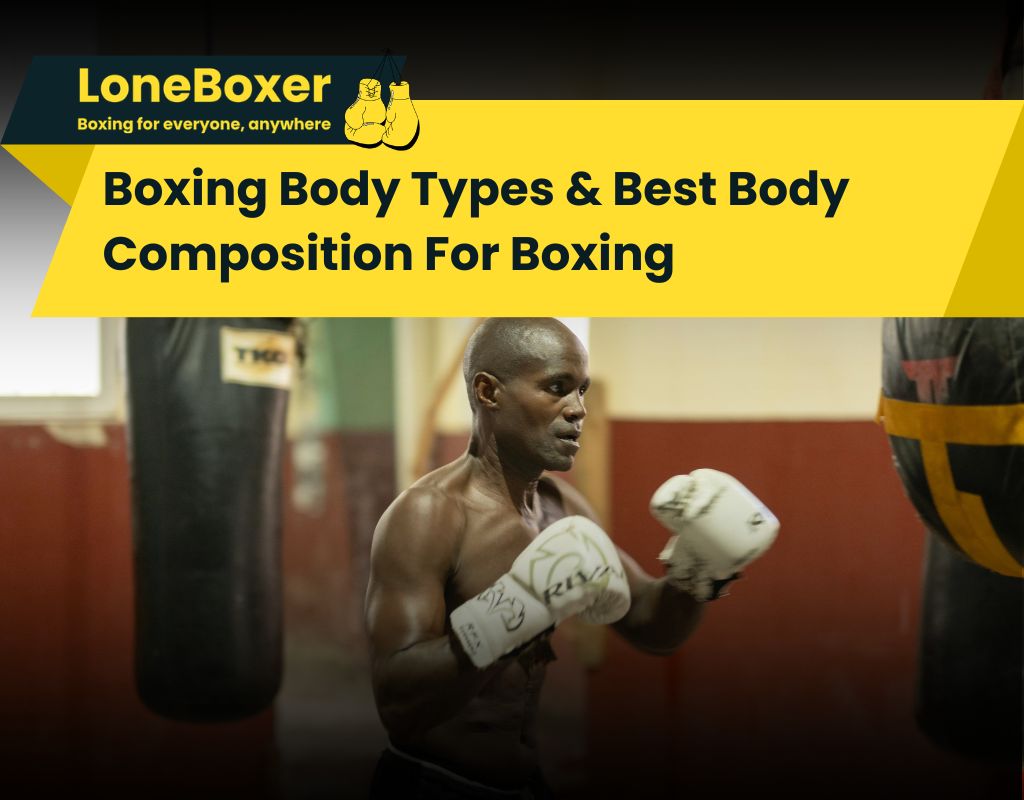
In the dynamic world of boxing, a fighter’s success hinges not only on skill and strategy but also on their unique physical composition. Understanding the nuances of the three main body types, endomorph, ectomorph, and mesomorph, is paramount for optimizing training and performance in the ring. Each body type presents distinct advantages and challenges, shaping a boxer’s approach to conditioning, technique, and overall strategy. In this exploration, we delve into the characteristics of these body types and their implications for boxing prowess, guiding fighters and coaches alike in crafting tailored training regimens for achieving peak performance.
What are body types?
In boxing, body types refer to the general physical build of a fighter and how that build can influence movement, power, speed, endurance, and preferred style in the ring. They are often described using the three somatotypes—endomorph, ectomorph, and mesomorph—to explain whether a boxer is more naturally stocky and powerful, lean and mobile, or muscular and well-balanced. While these categories can help describe physical tendencies, they are only rough guides, since skill, training, conditioning, and ring IQ matter just as much as body shape.
The three main body types are described below.
- Endomorphs:
Endomorphs typically possess a larger, stockier frame with higher levels of body fat. They often have wider hips and shoulders, giving them a more robust appearance. In boxing, endomorphs excel in generating power due to their larger build, making them formidable punchers, particularly in close-range combat. Their mass provides a level of natural protection against body shots. However, agility and speed may be compromised due to the extra weight. Endomorphs must focus on improving endurance and managing weight to maintain optimal performance in the ring. - Ectomorphs:
Ectomorphs are lean individuals with low body fat and narrow shoulders and hips. They tend to have a fast metabolism and struggle to gain muscle mass. In boxing, ectomorphs possess exceptional agility and speed, making them elusive targets in the ring. Their lean physique allows for quick movement and precise striking, giving them an edge in outmaneuvering opponents. However, generating power can be challenging due to their lighter frame. Ectomorphs need to focus on strength training to enhance their punching power and resilience against larger opponents. - Mesomorphs:
Mesomorphs have a muscular, athletic build with well-defined muscles and moderate levels of body fat. They typically have broad shoulders and a narrow waist. In boxing, mesomorphs are often considered the ideal body type due to their combination of strength, speed, and agility. They can generate significant power while maintaining excellent speed and movement around the ring. Despite their advantages, mesomorphs must still focus on conditioning and technique to maximize their potential in the ring. They may need to tailor their training regimen to address specific areas of improvement based on their individual strengths and weaknesses.
What’s the Typical Body Type of Boxers by Weight Class?
- Heavyweight (200+ pounds) boxers are typically mesomorphs or endomorphs. Deontay Wilder and Andy Ruiz Jr. exemplify mesomorph and endomorph body types, respectively.
- Cruiserweight (175-200 pounds) fighters often display mesomorph traits, sometimes with ectomorph features. Mairis Briedis and Oleksandr Usyk showcase this mesomorph build, with Usyk leaning towards ectomorph.
- Light Heavyweight (168 pounds) athletes are usually mesomorphs. Artur Beterbiev and Dmitry Bivol both possess the mesomorphic combination of power and speed.
- Super Middleweight (168 pounds) competitors may be mesomorphs or ectomorphs. Canelo Alvarez’s mesomorphic frame contrasts with Caleb Plant’s ectomorphic physique.
- Middleweight (160 pounds) boxers often have ectomorphic or mesomorphic bodies. Gennady Golovkin’s mesomorphic build provides power, while Jermall Charlo’s ectomorphic frame offers speed.
- Welterweight (147 pounds) fighters are typically ectomorphs. Terence Crawford and Errol Spence Jr. both utilize their ectomorphic advantages in speed and agility.
- Lightweight (135 pounds) boxers, like Vasyl Lomachenko and Teofimo Lopez, are ectomorphs, relying on speed and agility.
- Featherweight (126 pounds) athletes, such as Gary Russell Jr. and Josh Warrington, exhibit ectomorphic traits, emphasizing speed and conditioning.
- Super Bantamweight (122 pounds) competitors, including Stephen Fulton and Murodjon Akhmadaliev, are ectomorphs, focusing on speed and endurance.
- Bantamweight (118 pounds) fighters, like Naoya Inoue and Nonito Donaire, are ectomorphs, showcasing speed and technical skill.
- Super Flyweight (115 pounds) boxers, such as Juan Francisco Estrada and Roman Gonzalez, are ectomorphs, using speed to outmaneuver opponents.
- Flyweight (112 pounds) athletes, exemplified by Julio Cesar Martinez and Moruti Mthalane, are ectomorphs with exceptional speed and agility.
- Light Flyweight (108 pounds) competitors, like Kenshiro Teraji and Felix Alvarado, are ectomorphs, prioritizing speed and technique.
- Minimum-weight (105 pounds) fighters, such as Wanheng Menayothin and Knockout CP Freshmart, are ectomorphs, maintaining speed and a high work rate.
Are There Any Successful Endomorph Boxers?
Yes, successful endomorph boxers exist. Andy Ruiz Jr. exemplifies this body type, having defeated Anthony Joshua for the heavyweight title. His stocky build didn’t hinder his agility and power, showcasing an endomorph’s potential in the ring.
Can a Person With Endomorph Characteristics Become a Successful Boxer?
Yes, an individual with endomorph traits can become a successful boxer. Endomorphs, often characterized by a stockier build and higher body fat percentage, may leverage their natural strength and power in the ring. However, they’ll need rigorous training to enhance stamina and agility, crucial for boxing. A tailored nutrition and conditioning program can help optimize an endomorph’s performance, enabling them to compete effectively against other body types. Thus, with dedication and strategic training, endomorphs can excel in boxing.
What are the Benefits of Ectomorph Body Composition in Boxing?
Ectomorphs possess a lean build, offering speed and endurance advantages in boxing. Their lighter frames facilitate rapid movement, dodging punches with ease. Ectomorphs often enjoy a reach advantage, allowing them to strike opponents from a distance. However, they typically lack knockout power, thus relying on technical skills and agility. Consistent training can enhance muscle mass, improving punch resistance. Hence, ectomorphs excel in outboxing strategies, using their physical traits to outmaneuver and outlast adversaries in the ring.
What are the Benefits of Mesomorph Body Composition in Boxing?
Mesomorphs possess natural strength, thus they excel in power generation. Their muscular build aids in delivering forceful punches. Efficient energy use allows for sustained performance in bouts. Balanced body composition provides agility and speed, enhancing defensive maneuvers. Mesomorphs recover quickly, hence they maintain training intensity. However, they must manage their weight to stay within class limits. Mesomorphs adapt well to resistance training, improving overall boxing technique.
What’s The Best Body Type for Boxing?
Research suggests that mesomorphs may excel in boxing due to their balanced muscle mass and agility. In a study (Somatotype Analysis of Elite Boxing Athletes Compared with Nonathletes for Sports Physiotherapy) comparing the somatotype and physical characteristics of elite boxing athletes with non-athletes, it was found that the majority of elite boxers exhibited mesomorphic characteristics. Specifically, out of the participants, 16 were mesomorphs, four were ectomorphs, and two were central types, with only one endomorphic type observed. Mesomorphs’ ability to combine strength with agility allows them to adapt well to various boxing styles, whether emphasizing power or precision. This inherent advantage suggests that mesomorphs may be the most suitable body type for boxing, as their versatility and physical characteristics are optimized for the demands of the sport
Can an Ectomorph Become a Mesomorph?
Ectomorphs can’t change into mesomorphs, as body types are genetically determined. However, ectomorphs can build muscle and strength through targeted training and nutrition, thus appearing more mesomorphic.
Does Boxing Affect Muscle Growth?
Boxing without resistance enhances muscle endurance, not size. It involves high-intensity, repetitive movements, promoting cardiovascular strength and muscle endurance rather than hypertrophy. However, incorporating strength training into a boxing training regimen can lead to increased muscle mass. Thus, boxing alone doesn’t significantly affect muscle growth. The effects of boxing on muscle mass are typically caused by a combination of boxing with resistance exercises that yield sizeable results.
Is Boxing Effective For Weight Loss?
Yes, boxing can be effective for weight loss. Boxing training can improve body composition by reducing body fat, improving conditioning, and, when combined with resistance training, increasing muscle mass. High-intensity workouts, like sparring and bag work, burn significant calories. Boxing combined with resistance training can increase muscle mass, boosting resting metabolic rate, thus increasing calorie consumption further, making boxing a sport an effective weight loss strategy. Consistent practice of the sport can lead to sustained fat loss and body composition changes. However, dietary habits must complement physical activity for optimal results.