
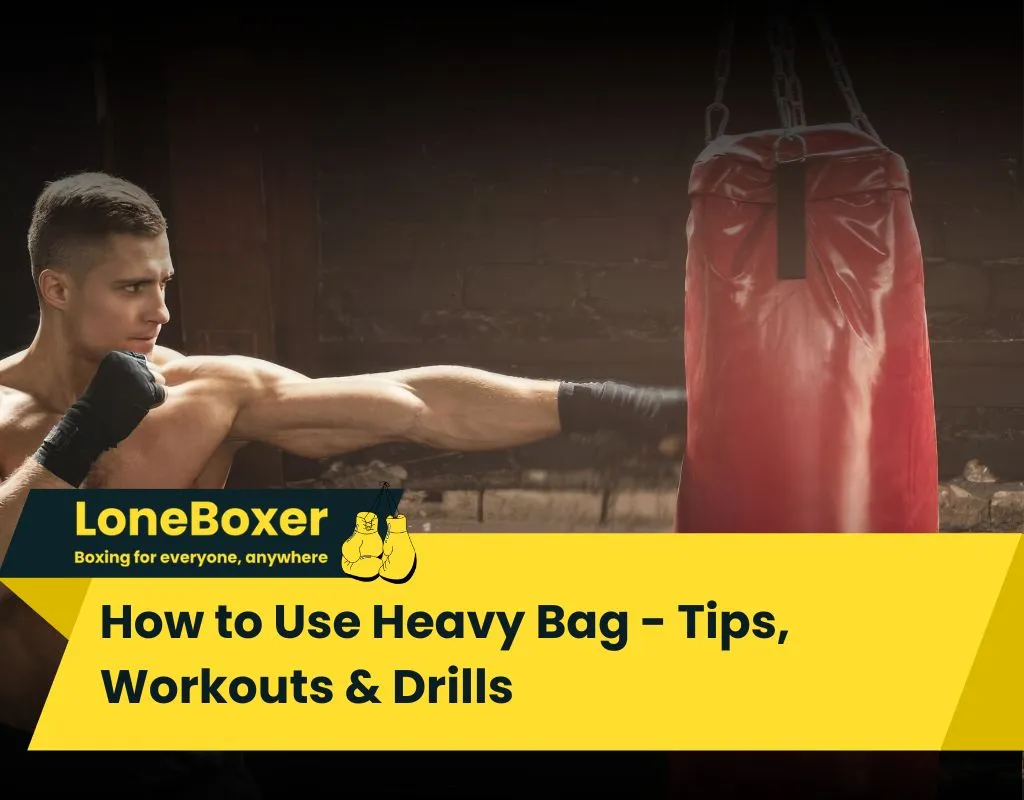
A heavy bag in boxing is a large, weighted training bag designed to absorb repeated punches while providing resistance that helps boxers develop power, endurance, technique, rhythm, and combination punching. Before engaging with a heavy bag, it’s important to wear hand wraps and heavy bag gloves to protect your hands and wrists. Heavy bag workouts are excellent for cardiovascular health, muscle strength, boxing technique, endurance, and stress relief, but must be done with proper form to avoid harm. Boxers utilize heavy bags to practice combinations like jab-cross to boost power and timing, hook-cross for lateral movement, and jab-uppercut-hook for rhythm and body mechanics. While rapid continuous punches are better suited to speed bags, heavy bags are ideal for training powerful, foundational strikes.
How to Properly Use a Heavy Bag?
To properly utilize a heavy bag, it must be suspended from a secure beam or stand. The ideal height for the bag is such that the middle of the bag lines up roughly with your chest to upper torso. For taller heavy bags, the bottom should not touch the ground, allowing for slight sway and rotation. Surrounding the bag, a clearance of at least 60 centimeters (2 feet) is necessary to facilitate movement and various striking angles.
Can you use the heavy bag without hanging it? While unconventional, stationary heavy bags exist, they lack the dynamic movement essential for realistic training and full technique development.
With the heavy bag correctly set up, we’ll delve into practical methods to engage with it purposefully, enhancing both technique and conditioning.
1. Wrap Your Hands
Wrapping your hands stabilizes the wrist and knuckles, preventing injuries during heavy bag workouts. It’s essential because the repetitive impact can strain the delicate bones and tendons in your hands. For optimal protection, ensure the wrap is snug but not too tight, allowing for circulation and movement. Don’t forget to evenly distribute the wrap across the hand, paying extra attention to the wrist and thumb for added support.
2. Get Into a Proper Stance
A proper stance ensures balance and power when hitting a heavy bag. It’s the foundation for effective strikes. To nail it, keep your feet shoulder-width apart, with your non-dominant foot forward. This position allows for quick movements and solid punches. Your weight should be evenly distributed, enabling swift transitions from offense to defense. Remember to keep your knees slightly bent for better shock absorption and agility. Thus, a well-executed stance not only maximizes the impact of your blows but also keeps you ready to react to any training scenario the heavy bag can simulate.
3. Be Aware Of Your Hand Position
Keeping your fists tightly clenched and your wrists straight is essential to prevent injury and maintain proper form. It not only protects your wrists but also optimizes the impact of your punches.
When throwing punches, it’s crucial to rotate them from the shoulder. This rotational movement not only generates power but also protects by keeping your elbows tucked in close to your body. By rotating punches from the shoulder, you engage the larger muscles of your upper body, maximizing both striking force and defensive stability.
Therefore, maintaining proper hand alignment, along with shoulder rotation, is key to ensuring both safety and effectiveness in your heavy bag training sessions. It’s a fundamental aspect of boxing technique that every boxer should prioritize and consistently practice.
4. Practice Striking
Practicing striking on a heavy bag is essential for developing power and technique. The bag’s resistance mimics an opponent’s body, allowing you to work on the force behind your punches. To maximize power, rotate your hips with each strike and ensure you’re hitting through the bag, not just the surface. Aim for specific spots on the bag to refine your precision. Imagine the bag as an actual opponent, targeting areas like the chin or ribs, and maintain your focus on these points as you strike.
5. Learn Correct Breathing Techniques
Correct breathing techniques enhance stamina and power in boxing. When hitting a heavy bag, exhale sharply with each punch; this stabilizes the core and maximizes force. Inhale deeply between combinations to maintain oxygen levels, ensuring muscles don’t fatigue prematurely. Thus, rhythmic breathing aligns with movement, creating a steady flow and preventing early exhaustion.
6. Throw Combinations
1. Jab-Cross: Establishes distance, sets up power shots. On the heavy bag, focus on snapping your jab back quickly to guard your face, and pivot your back foot during the cross to maximize power.
2. Jab-Cross-Hook: Disrupts opponent’s guard, creates openings. Ensure you’re rotating your torso with the hook for added force on the bag, and keep your non-punching hand up to protect your chin.
3. Jab-Upper Cut: Targets body and head, breaks through tight defenses. Practice dropping your lead hand slightly before the uppercut to generate momentum, but don’t telegraph the punch to the bag.
4. Cross-Hook-Cross: Overwhelms with power, maintains offensive pressure. On the bag, exhale sharply with each punch to maintain rhythm, and reset your stance quickly after the combination to stay balanced.
5. Jab-Body Hook-Head Hook: Mixes levels, confuses defense. Aim to pivot on your lead foot when throwing the body hook and keep your elbow parallel to the ground for the head hook to ensure proper form on the bag.
6. Double Jab-Cross: Reinforces range control, sets a rhythm. Keep the first jab light and quick to distract, then drive through with a powerful cross, using the bag to practice generating force from your legs and hips.
7. Jab-Cross-Jab-Cross: Establishes a rapid-fire offense, tests the opponent’s defense. Aim for speed and precision with each jab, then explode through with power on the crosses, maintaining a quick rhythm on the bag.
8. Jab-Cross-Jab-Feint: Sets up for counter-attacks, and baits opponent’s reactions. After the second jab, sell the feint with convincing body movement and eye contact, then quickly assess the opponent’s response before deciding on the next action on the bag. Use the feint to set up additional combinations.
7. Add Footwork And Defense Movements
Footwork and defense movements are crucial for a boxer’s agility and safety in the ring. They enable fighters to position themselves effectively, dodge blows, and counterattack with precision. When working the heavy bag, incorporating footwork helps simulate a real bout, enhancing your ability to move and strike fluidly under pressure. For defense, practice pivoting around the bag after throwing combinations, mimicking evasive maneuvers. Additionally, integrate slips and rolls into your routine to build muscle memory for avoiding punches. Thus, your heavy-bag sessions become a comprehensive workout, sharpening both your offensive and defensive arsenals.
8. Choose Adequate Intensity and Duration for Practice
Choosing the right intensity and duration for heavy bag workouts is crucial for maximizing boxing skills and preventing injury. Training too hard can lead to burnout or damage, while going too light might not challenge your body enough to improve. For beginners, moderate intensity for short rounds, like two minutes with a minute rest, helps build stamina without overwhelming it. As you progress, increase to three-minute rounds to mirror professional bouts. It’s also smart to mix up the pace; start with a warm-up pace, then incorporate bursts of high intensity to simulate the ebb and flow of a real fight. Remember, consistency beats intensity in the long run, so it’s better to train smarter, not just harder.
9. Don’t Forget to Cool Down
Cooling down after a heavy bag workout is crucial for recovery. It gradually lowers your heart rate, preventing dizziness and reducing muscle stiffness. Hence, skipping this step can lead to unnecessary discomfort or even injury. To cool down effectively, start with light shadow boxing, focusing on form and breathing. Incorporate dynamic stretching targeting the shoulders, back, and legs to enhance flexibility and aid in the dispersal of lactic acid. These practices not only safeguard your well-being but also improve your readiness for the next training session.
10. Monitor Your Progress
Measuring your performance allows for setting realistic goals, maintaining motivation, and recognizing when it’s time to increase the intensity or complexity of your heavy bag workouts.
- Record Your Sessions: Keep a training journal or use a workout tracking app to record each session. Note down the date, duration of the workout, and any specific drills or techniques you focused on.
- Measure Punches: Count the number of punches thrown during each session. This can give you an indication of your work rate and endurance. Over time, you should see an increase in the number of punches thrown as your conditioning improves.
- Track Force Applied: If possible, use a device like a punch tracker or a force-measuring tool to gauge the force of your punches. This metric can help you assess your power and strength development.
- Duration of Workouts: Keep track of how long you spend on the heavy bag during each session. Gradually increasing the duration can help build endurance and stamina.
- Video Analysis: Record your heavy bag workouts regularly and review the footage to analyze your form and technique. Look for areas where you can improve, such as footwork, punching technique, and defensive maneuvers. Compare your current sessions with previous ones to identify progress and areas for further development.
- Set Realistic Goals: Based on your observations and analysis, set specific and achievable goals for improvement. Whether it’s increasing the number of punches per round, improving punching technique, or enhancing overall speed, setting targets can help you stay focused and motivated.
- Adjust Training Regimen: Use your progress tracking data to adjust your training regimen accordingly. If you notice areas where you’re lagging or plateauing, consider incorporating new drills or exercises to address those weaknesses. Conversely, if you’re consistently improving, gradually increase the intensity or complexity of your workouts to continue challenging yourself.
- Maintain Motivation: Seeing tangible evidence of your progress can be highly motivating. Celebrate small victories along the way and use setbacks as opportunities to learn and grow.
Can You Use a Heavy Bag Without Gloves?
Yes, you can use a heavy bag without gloves. To do so, start with hand wraps to protect your wrists and knuckles. Gradually condition your hands, beginning with light punches to build tolerance. Focus on proper technique to avoid injury. Monitor your hands for signs of stress.
Training without gloves on a heavy bag may seem unconventional, but it has its reasons. Some opt for this approach to toughen their hands and knuckles over time, crucial for martial arts or combat sports. Without gloves’ padding, it forces practitioners to focus on perfecting the punching technique, enhancing precision. It offers a realistic scenario for self-defense training. However, caution is vital. Always wear hand wraps for protection and start with light punches, gradually increasing intensity. Emphasize proper technique to minimize injury risk. Monitor for any discomfort in the hands to prevent injuries.
Is Hitting a Heavy Bag Good Workout?
Hitting a heavy bag is an effective workout. It enhances cardiovascular health, builds muscle strength, and improves boxing technique. This boosts endurance and aids in stress relief. However, proper form is essential to prevent injury. Thus, heavy bag training is beneficial when executed with care.
What are Example Workouts With Heavy Bag
Boxers enhance power and endurance through heavy bag workouts. A typical session includes three-minute rounds with one-minute rest intervals, mimicking fight conditions.
Workout 1: Basic Combination Drills
- Round 1: Jab, cross (1-2 punch combo) – 3 minutes.
- Round 2: Jab, cross, hook (1-2-3 punch combo) – 3 minutes.
- Round 3: Jab, cross, hook, uppercut (1-2-3-4 punch combo) – 3 minutes.
- Round 4: Double jab, cross, hook, cross (1-1-2-3-2 combo) – 3 minutes.
- Round 5: Jab, cross, hook to the body, hook to the head (1-2-3B-3 combo with body shot) – 3 minutes.
- Round 6: Jab, feint, cross, hook, uppercut, cross (1-feint-2-3-4-2 combo) – 3 minutes.
Workout 2: Power Punches
- Round 1: Single power jabs – 3 minutes.
- Round 2: Right-hand power crosses – 3 minutes.
- Round 3: Left hook power shots – 3 minutes.
- Round 4: Right uppercut power shots – 3 minutes.
- Round 5: Rear straight power punches (straight with the rear hand) – 3 minutes.
- Round 6: Lead uppercut-hook-cross (lead hand uppercut, hook, cross combo) – 3 minutes.
Workout 3: Endurance and Speed
- Round 1: Continuous light jabs and crosses – 3 minutes.
- Round 2: Quick hooks and uppercuts, alternating hands – 3 minutes.
- Round 3: Freestyle punching, maintaining high intensity – 3 minutes.
- Round 4: Continuous jab-cross-jab-cross – 3 minutes.
- Round 5: Alternating hooks to the body and head – 3 minutes.
- Round 6: Double jab, triple cross, hook combo – 3 minutes.
Workout 4: Defense and Counterattack
- Round 1: Jab, slip, cross – 3 minutes.
- Round 2: Cross, duck, hook – 3 minutes.
- Round 3: Jab, parry, cross, hook – 3 minutes.
- Round 4: Slip outside, counter with cross – 3 minutes.
- Round 5: Roll under, counter with hook – 3 minutes.
- Round 6: Slip inside, counter with uppercut – 3 minutes.
Workout 5: High-Intensity Interval Training (HIIT)
- Round 1: 30 seconds: Max effort punches – 30 seconds; Rest or light shadowboxing.
- Round 2: 30 seconds: Continuous hooks and uppercuts – 30 seconds; Rest or active recovery footwork.
- Round 3: 30 seconds: Rapid-fire jab-cross combinations – 30 seconds; Rest or controlled breathing.
- Round 4: 30 seconds: Alternating power shots – 30 seconds; Rest or light movement.
- Round 5: 30 seconds: Continuous body shots – 30 seconds; Rest or light shadowboxing.
- Round 6: 30 seconds: All-out flurries – 30 seconds; Rest or controlled breathing.
Repeat for 2-3 times, to increase aerobic and anaerobic capacity.
Each workout targets specific skills, from technique refinement to brute strength. Consistency and variation in heavy bag training yield optimal fight readiness.
How to Use Heavy Bags for Weight Loss?
To use heavy bags for weight loss, maintain a steady heart rate through sustained, vigorous punching and movement (between 120-130 bpm for fat burning). Aim for sessions lasting at least 30 minutes to increase fat burn. As one becomes more trained, they can incorporate intervals, alternating between intense bursts and moderate pace to boost metabolism.
What Drills Can You Do With a Heavy Bag?
Heavy bag is a useful piece of gear to practice drills such as:
- Movement drills enhance agility; they involve circling the heavy bag, practicing pivots, and integrating head movement.
- Defense drills develop guard skills; they include slipping punches, bobbing and weaving, and counter-punching against the bag.
- Boxing combination drills improve offensive techniques; they consist of executing jab-cross-hook-uppercut sequences and varying punch speeds and power.
What Boxing Combinations to Practice on a Heavy Bag?
Boxers practice jab-cross combos on heavy bags to enhance power and timing. They also drill hook-cross sequences for improved lateral movement and punch fluidity. Jab-uppercut-hook combinations develop rhythm and body mechanics. However, speed-focused flurries, such as rapid-fire uppercuts, are better suited to bags such as a teardrop bag or double-end bag. Thus, while heavy bags are ideal for honing forceful, foundational strikes, alternative bag types better serve certain speed and precision drills.
What are Other Types of Boxing Bags?
Heavy bags build power; speed bags improve rhythm. Double-end bags enhance accuracy; uppercut bags develop precision. Maize bags dodge headshots, thus honing defense.
1. Speed Bag
A speed bag sharpens a boxer’s hand-eye coordination and timing. Fighters practice rapid punches, alternating left and right hands, to maintain rhythm and build endurance. It’s not for power; it’s for speed and precision. Common combos include straight punches and circular motions, enhancing a pugilist’s reflexes and punch accuracy.
2. Reflex Bag
A reflex bag sharpens a boxer’s timing and accuracy. Fighters strike it to enhance hand-eye coordination and develop rhythm. Common drills include jab-cross combos and slip-counter techniques. Quick, repetitive punches improve reaction speed, while dodging the bag’s rebound hones defensive maneuvers. Thus, the reflex bag serves as a dynamic tool for simulating a moving opponent.
3. Free Standing Punching Bag
A free-standing punching bag serves as a versatile training tool to hone striking skills. It withstands powerful blows, allowing practitioners to execute a myriad of punches and combinations. Fighters develop their jab, cross, hook, and uppercut techniques, enhancing accuracy and power. Additionally, they practice footwork and timing, simulating a real opponent’s movement. The bag’s stability is ideal for high-intensity combos, thus improving cardiovascular endurance and overall fitness. However, its mobility allows for easy repositioning within a training space, offering convenience and flexibility in workout routines.
What’s The Difference Between Heavy Bag Work and Shadowboxing?
Heavy bag work involves striking a weighted bag to improve power and technique; shadowboxing involves throwing punches in the air to enhance form and footwork.
What’s the Difference Between a Heavy Bag and a Free-Standing Punching Bag?
A heavy bag hangs from a ceiling or stand, offering resistance and sway for dynamic training. A free-standing punching bag stands on a base, providing stability without complex installation, suitable for spaces where hanging a bag isn’t feasible. Heavy bags typically require a solid, secure mount and can accommodate full-power strikes, improving a boxer’s power and technique. Free-standing bags are easier to move and set up, but may lack the same level of resistance and feedback for developing striking power.
What are the Benefits of Training on a Heavy Bag?
Heavy bag training enhances punching power. It improves cardiovascular endurance. The activity hones boxing technique and hand-eye coordination. It also builds muscle strength and stamina. Heavy bag workouts increase metabolic rate, thus burning calories, helping to shed weight. It’s also convenient for solo practice; hence, heavy bag sessions are a great way to train for boxers’ conditioning as a professional or a novice.