
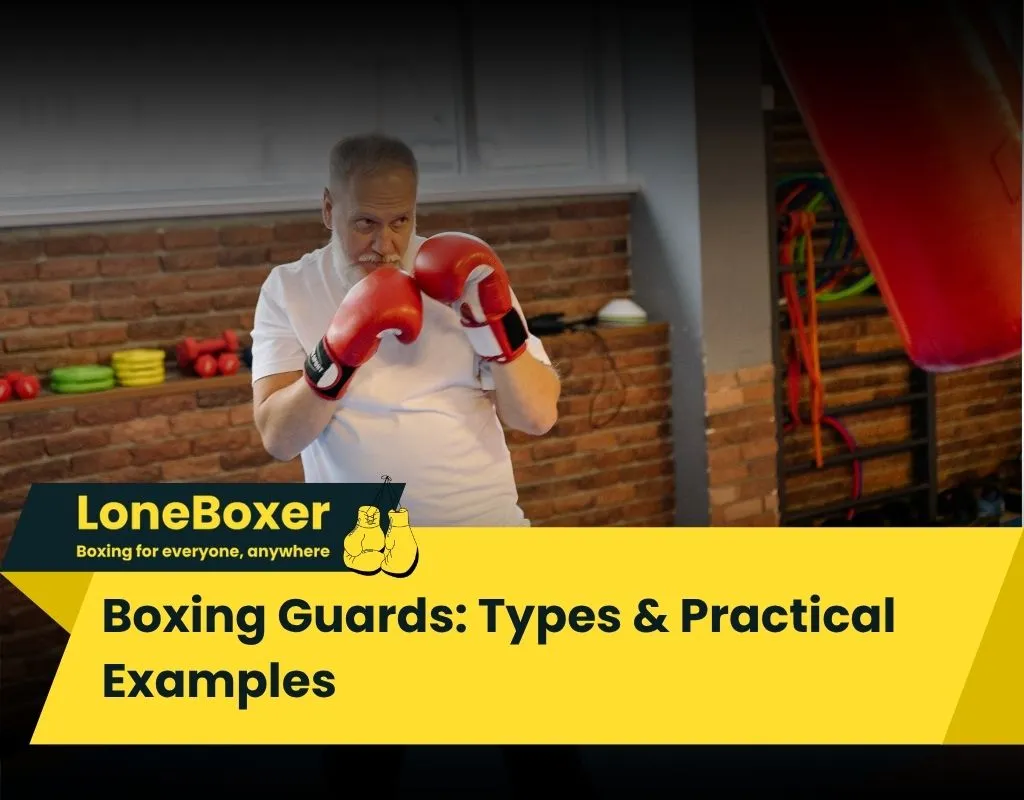
Boxing guards refer to specific hand and arm positions used to protect against an opponent’s punches. Boxers practice these guards through shadowboxing, which hones shifts between high guard and Philly shell, and sparring, where techniques like the peek-a-boo style and cross-armed defense are tested under pressure. While often confused with guards in boxing, the terms orthodox and southpaw represent conventional stances and do not refer to the type of guard a fighter uses.
How Many Guards Are There in Boxing?
The six main guards used in boxing are listed below.
- High Guard
- Cross Arm Guard
- Low Guard
- Peek-a-boo Guard
- Philly Shell Guard
- Open Guard
1. High Guard
High guard involves fighters raising their gloves to protect the face and head. Hands are positioned near the temples, elbows tucked close to the body, creating a shield. This guard is adaptable to both orthodox and southpaw stances, offering a balanced defense.
The High Guard stands as a stalwart defense, providing a formidable shield against head strikes. Its straightforward execution allows fighters to swiftly transition from defense to offense, making it a favorite among those who favor a tight defensive style. However, its effectiveness comes at the cost of limited peripheral vision, potentially leaving fighters vulnerable to attacks targeting the body. Over-reliance on the High Guard can lead to predictability, as opponents may exploit its weaknesses with strategic maneuvering and varied strikes.
Wladimir Klitschko, a heavyweight champion, excelled with the high guard. His towering frame and technical prowess made the guard a cornerstone of his defensive strategy.
2. Cross Arm Guard
Cross Arm Guard involves crossing the forearms in front of the torso. Boxers position the lead hand’s forearm horizontally across the belly, and the rear hand’s forearm vertically along the centerline. This guard’s purpose is to shield against body shots and straight punches.
The Cross Arm Guard offers a robust defense for the torso, with forearms crossed in front of the body to shield against body shots and straight punches. Its ability to confuse opponents and facilitate quick transitions to counterattacks makes it a versatile option in the ring. However, the Cross Arm Guard leaves the head exposed, particularly against hooks and wide-angle strikes. Fighters must carefully balance its protective benefits with its vulnerabilities to maintain an effective defensive strategy.
The Cross Arm Guard suits the orthodox stance, providing a robust defense against orthodox fighters. However, it’s less effective against southpaws, as the southpaw fighters’ hands can exploit the Cross Arm Guards of orthodox fighters more easily due to the body angle and distance.
Archie Moore, an orthodox stance fighter, adeptly used the Cross Arm Guard, neutralizing opponents’ body attacks.
3. Low Guard
Low guard positions hands below chin level, often near waist, with elbows tucked in. Body remains upright or slightly leaned forward, feet in a balanced stance.
The Low Guard entices opponents with its lowered hand position, creating openings for strategic counterpunching while conserving energy. This guard enhances the execution of body shots and invites opponents to overcommit, providing opportunities for swift and decisive counters. Yet, its lower hand position increases vulnerability to head strikes, requiring fighters to possess exceptional reflexes and head movement proficiency to evade incoming punches effectively. Mastery of the Low Guard demands a delicate balance between baiting opponents and maintaining defensive readiness.
Floyd Mayweather Jr. excelled with a low guard, especially in his orthodox stance, masterfully countering while minimizing damage through superior defensive tactics.
4. Peek-a-boo Guard
Peek-a-boo guard involves a fighter’s hands held high, elbows low, and close to the body. The boxer’s head tucks in behind the gloves, allowing vision through the arms, resembling the children’s game “peek-a-boo.” This guard is effective in the orthodox stance, where the left foot is forward, providing a solid defensive front.
The Peek-a-boo guard excels in providing strong protection against head and body shots while facilitating quick counter-punching opportunities. However, its limitation lies in its potential to restrict peripheral vision and mobility, particularly against opponents with a reach advantage or adept at throwing hooks.
Mike Tyson excelled with the peek-a-boo guard, using it to aggressively close distance and unleash powerful combinations. Tyson’s compact, explosive style capitalized on the guard’s strengths, making him a formidable opponent in the ring.
5. Philly Shell Guard
Philly Shell Guard, also known as the Shoulder Roll Guard, positions the boxer’s lead arm across the torso, the rear hand high near the cheek to protect the chin. The boxer’s body leans back slightly, shoulder raised to shield the jaw. This guard is often adopted in an orthodox stance, where the left shoulder is in front, though southpaws can adapt it with the right shoulder forward.
The Philly Shell Guard offers strong counterpunching capabilities and energy efficiency, particularly against straight punches when executed correctly. However, its weaknesses include vulnerability to aggressive body attacks and overhand rights, especially if the boxer’s timing is off.
Floyd Mayweather Jr. excelled with the Philly Shell, showcasing its defensive prowess and counter-striking potential in the orthodox stance.
6. Open Guard
Open Guard is a looser defensive guard that positions the boxer with hands lowered, maintaining a wider distance between the feet. The boxer’s lead hand hovers near chest level, the rear hand at the chin, ready to counter. This guard can be used to bait opponents, encourage overcommitment, and facilitate swift counterstrikes.
The Open Guard excels in enhancing mobility, managing distance deceptively, and capitalizing on rapid counterpunching opportunities. However, it’s vulnerable to aggressive combinations and susceptible to body shots due to the lowered hand position.
Prince Naseem Hamed adeptly utilized the Open Guard, drawing opponents in and countering with precision, particularly in his southpaw stance.
How to Practice Different Guards?
To practice different guards, boxers incorporate shadowboxing and sparring. Shadowboxing allows fighters to shift between guards, such as the high guard and the Philly shell, refining defensive movements without resistance. Sparring provides real-time feedback, as transitioning from a peek-a-boo style to a cross-armed defense against an opponent tests effectiveness under pressure.
What’s the Best Guard for Boxing?
The best guard in boxing often depends on the fighter’s style and situation. The high guard, favored by many defensive boxers, effectively protects against headshots. Fighters like Wladimir Klitschko utilized it to dominate the heavyweight division. The Philly Shell, used by Floyd Mayweather Jr., offers counter-punching opportunities, contributing to his undefeated record. Statistics on guard effectiveness are scarce, but success rates of boxers like Mayweather suggest the Philly Shell’s efficacy in professional bouts. The peek-a-boo style, popularized by Mike Tyson, showcases aggressive offense while maintaining defense, proving successful in his knockout victories. Thus, while there’s no one-size-fits-all guard, the high guard and Philly shell are among the best-known and most successful guard styles used at a high level.
How to Know What Guard I Should Use?
Choosing the right guard in boxing depends on your fighting style, reach, and opponent’s tactics. For an aggressive style with shorter reach, a high guard protects against headshots. Conversely, a fighter with a longer reach may prefer a low guard, leveraging reach advantage to counter. Analyzing your opponent’s strategy is crucial; if they target the body, adopt a tighter guard there. Moreover, adaptability is key; switch guards to confuse your opponent and respond to their adjustments. Regular sparring reveals personal comfort and effectiveness, guiding guard selection. Thus, the optimal guard is determined through a mix of personal attributes, opponent analysis, and practical experience.
Determining the Appropriate Guard
The approach to selecting the appropriate guard involves considering a combination of factors, including fighting style, reach, opponent tactics, height, and size. Experimentation, experience, and adaptation are key as fighters refine their guard strategy to best suit their individual attributes and maximize their chances of success in the ring.
For taller fighters, especially those with a longer reach, a guard that emphasizes maintaining distance and capitalizing on their reach advantage may be preferable. This could include guards like the long guard or the jab-and-retreat style, which allow taller fighters to control the distance, jab effectively, and avoid getting caught in close-range exchanges where their shorter opponents might have an advantage.
Conversely, shorter fighters may benefit from guards that emphasize defense and protection, given their potentially smaller stature and shorter reach. Guards like the high guard or the peek-a-boo guard can provide effective protection against taller opponents’ strikes while allowing shorter fighters to work their way inside and unleash powerful combinations at close range.
In terms of size, a larger, more muscular fighter may prioritize guards that provide solid protection against incoming strikes, such as the high guard or the Philly shell guard, to withstand the impact of opponents’ punches. Conversely, a smaller, more agile fighter may prefer guards that emphasize mobility and quick counter-attacks, such as the open guard or the philly shell, to evade incoming strikes and capitalize on speed and agility.
How to Block in Boxing?
In boxing, blocking is one of the many defense tactics that involves positioning the arms and gloves to shield against incoming punches. To block a jab or cross, a fighter raises the gloves to forehead level, elbows tucked in, deflecting blows off the gloves. For hooks, the boxer shifts the arm on the side of the incoming punch, creating a barrier between the torso and glove. Body shots are blocked by dropping the elbows and compressing the midsection, using the arms to absorb the impact.
How Does a Boxing Stance Affect the Effectiveness of a Guard?
A boxer’s stance directly influences guard effectiveness. A wider stance offers greater stability, which can help a boxer stay balanced when defending body shots or absorbing pressure. Conversely, a narrower stance allows for quicker upper-body movement, aiding in the defense against head strikes. An orthodox fighter’s left-hand lead typically results in a stronger guard on their left side, while a southpaw’s right-hand lead does the same for their right side. The opponent’s stance also matters; an orthodox fighter may find it harder to penetrate a southpaw’s guard due to the angle of attack and vice versa. Thus, stance and guard are interdependent, with each boxer’s position dictating the guard’s strengths and vulnerabilities.
What’s the Difference Between Boxing Guards and Stances?
Boxing guards refer to the defensive hand positions fighters adopt to protect themselves from blows. Stances, however, denote the overall body positioning and footwork a boxer maintains while fighting or preparing to strike. Guards focus on upper body protection, while boxing stances encompass the boxer’s full posture, affecting balance, movement, and offensive capability. Guards vary in height and angle to shield against different attacks; stances differ in weight distribution and foot alignment, influencing agility and power. Thus, guards are a component of stances, which are more comprehensive in scope.