
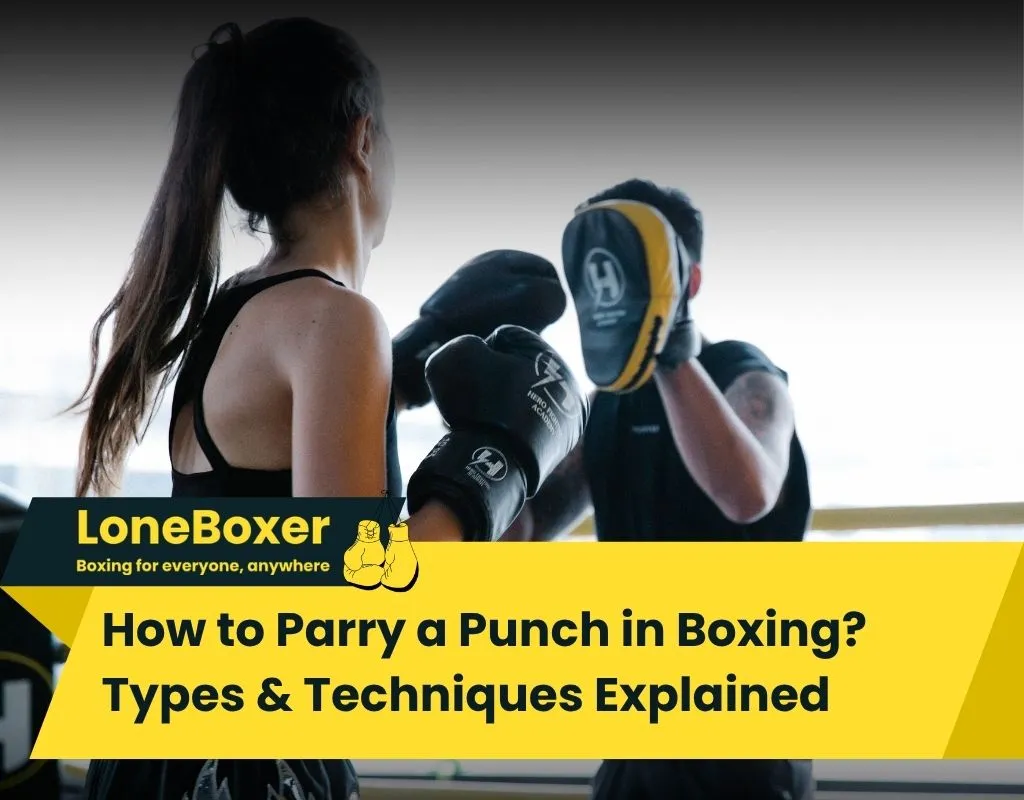
In boxing, a parry is a defensive technique distinct from head movement, blocking, or footwork. It involves deflecting an opponent’s punch to redirect its force, rather than absorbing the impact as a block does. This tactic requires precise timing and minimal movement, allowing the boxer to maintain balance and readiness for a counterattack. In its simplest form, boxers most often parry straight punches such as jabs and crosses, though the exact motion can vary depending on the punch, angle, and stance matchup. Parries offer the advantage of preventing damage while creating opportunities for counterstrikes, as opposed to blocks that primarily reduce the force of hits but may offer fewer chances for immediate retaliation.
How Do You Parry a Punch in Boxing?
In an orthodox stance, a fighter parries a jab with the rear hand, redirecting the incoming punch by pushing it sideways. A southpaw usually parries the opponent’s lead jab with the rear hand in the same basic way.
To parry a cross in an orthodox stance, the boxer uses the lead (left) hand, guiding the punch away laterally. A southpaw, facing an orthodox opponent’s cross, employs the lead (right) hand for the parry, applying the same lateral deflection technique.
In general, boxers often use the rear hand to parry jabs and the lead hand to parry crosses, though the exact choice can vary depending on stance, angle, and preferred style.
Advanced Parrying Types and Techniques
- Outside Parry: This technique involves deflecting an opponent’s jab by pushing it to the outside with your back hand. To execute it effectively, push off your back foot while simultaneously using your back hand to redirect the incoming punch. It’s particularly effective against a lazy or telegraphed jab. When performed correctly, it not only defends against the jab but also sets you up for a counterpunching opportunity. Common faults include exaggerating the movement, which can leave you open to follow-up attacks, and relying solely on arm movement rather than engaging your entire body.
- Down Parry: The down parry is best suited for defending against straight punches like crosses and jabs. Instead of pushing the opponent’s punch to the side, as with the outside parry, you deflect it downward. This can disrupt the opponent’s attack while creating openings for counters or positional advantages. Proper timing and placement are crucial to effectively redirecting the punch downward without exposing yourself to other strikes.
- Side Parry: Unlike the down parry, the side parry involves redirecting your opponent’s punch to the side rather than down. By forcing your opponent’s hands to the side, you can create openings for counters or create space to maneuver. This technique is versatile and can be used against various types of strikes, depending on the situation. Like other parrying techniques, it requires precise timing and positioning to be effective.
- Loop Parry: The loop parry is a defensive maneuver where you push your opponent’s looping punches, such as hooks to the body, to the side, away from your torso. This technique is particularly useful for defending against looping punches that target the sides of your head or body. By redirecting the punch away from your centerline, you minimize the risk of taking a direct hit while creating opportunities for counterattacks. As with other parries, timing and proper execution are essential to successfully deflecting the incoming strike.
What are Common Mistakes Made With Parrying?
Common mistakes with parrying include mistiming, overcommitting, and incorrect distance. Fighters often misjudge an opponent’s speed, thus parrying too early or too late, leading to vulnerability. Overcommitting to a parry can result in loss of balance and open defense. Incorrect distance, or misjudging the range, can cause a parry to miss entirely, leaving the fighter exposed to strikes.
To remedy mistiming, fighters should sharpen their reflexes and improve their anticipation through drills and sparring. For overcommitment, it’s crucial to practice controlled movements, ensuring parries are efficient and don’t compromise stance. To correct distance errors, boxers must develop a keen sense of range, often through pad work and controlled sparring, focusing on reading their opponent’s movements.
What are the Drills to Practice Parrying?
To practice parrying in boxing, drill with a partner, throwing slow, controlled jabs and crosses, while the other trainee focuses on deflecting the punches using minimal movement and sharp hand motions. Another way to practice is using a double-end bag to develop timing and hand precision as the bag rebounds quickly and unpredictably.
What’s The Difference Between Parry And A Block?
A parry deflects an opponent’s punch, redirecting its force. A block absorbs the impact, often using the arms or gloves to shield against the blow. Parries require precise timing and skill to execute effectively, while blocks rely more on positioning and endurance to withstand strikes. Thus, parrying can prevent taking damage and create counterattacking opportunities, whereas blocking reduces the damage of incoming hits but may leave fewer openings for immediate retaliation.
Is Blocking Better Than Parrying Punches?
Blocking isn’t necessarily better than parrying punches; it’s situational. Blocking conserves energy but can leave one open to feints. Parrying deflects attacks, creating counter opportunities, yet requires precise timing. Thus, fighters often blend both defenses tactically.
How to Counter Opponents’ Parry?
To counter an opponent’s parry in boxing, feint punches to disrupt their timing. This tactic deceives them into parrying prematurely, creating openings for actual strikes. Additionally, vary your attack angles and rhythms to make your movements less predictable and harder to parry. Utilize combinations, integrating body shots and head punches, to overwhelm their defense. Once they commit to the parry, follow immediately with another punch from a different line.
What are the Alternative Defenses in Boxing?
Boxers employ various defensive techniques to evade or block punches. The slip involves a slight rotation to the side, dodging an opponent’s blow. Bobbing and weaving entail moving the head and upper body in patterns to avoid strikes. The parry deflects an incoming punch using the boxer’s hand or forearm. Clinching involves a boxer grappling to limit the opponent’s offensive options. The pull-back defense relies on a quick backward lean to escape a punch. The shoulder roll utilizes the boxer’s shoulder to deflect attacks and set up counterpunches. Footwork is crucial, allowing fighters to maintain distance or angle away from danger. Hence, mastery of these defense moves enhances a boxer’s ability to protect themselves and control the bout’s tempo.