
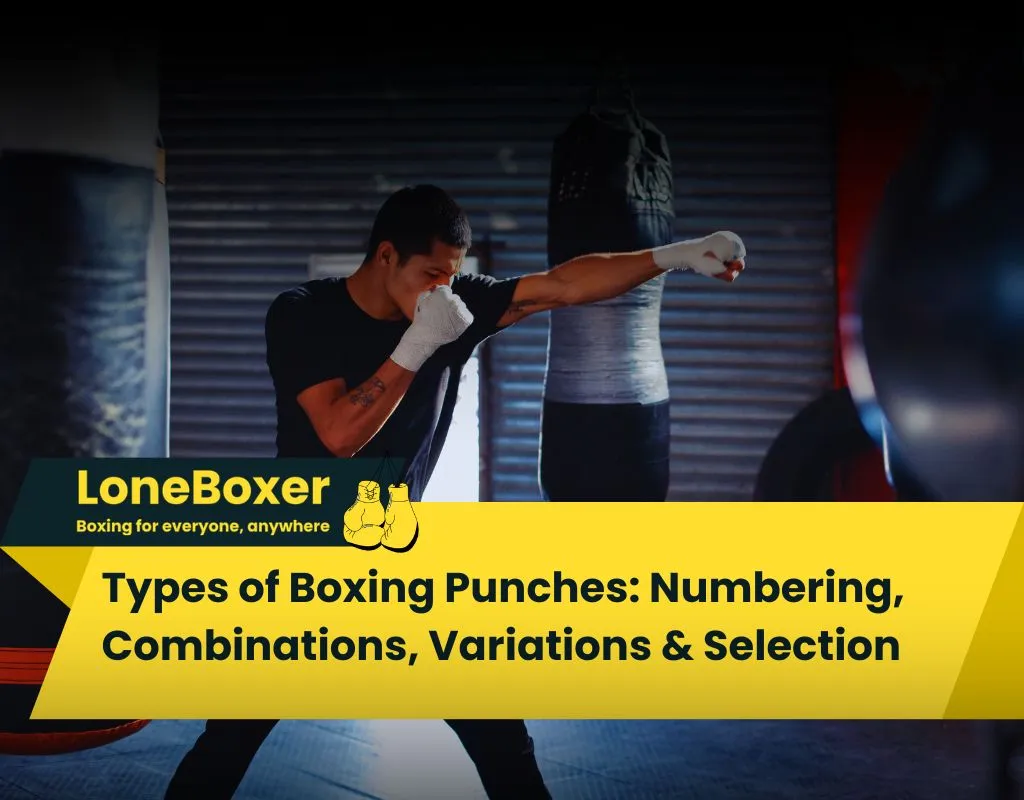
Boxing punches are categorized into four main types: jabs, crosses, hooks, and uppercuts. Jabs are quick, straight strikes for maintaining distance and rhythm disruption. Crosses deliver rear-hand damage and penetrate guards. Hooks, thrown in a curved motion, target the opponent’s jaw, while uppercuts aim upward at the chin or body. Each punch’s effectiveness is influenced by the boxer’s stance, with orthodox and southpaw positions optimizing different power shots. Mastery of these punches, including their variations and combinations, is essential for a boxer’s offensive and defensive strategies.
How are the Boxing Punches Numbered?
Boxing punches are numbered for streamlined communication in training. The numbering system simplifies complex combinations. It’s widely attributed to coach Ray Arcel, though concrete evidence of its origin remains elusive. The system typically starts with the jab as “1,” the right cross as “2,” the left hook as “3,” and the right hook as “4.” Upper cuts follow, with the left uppercut as “5” and the right uppercut as “6.” Some coaches expand with additional numbers for modified punches.
Different punches and their respective punches are featured in the table below.
| Number | Punch | Description |
| 1 | Jab | A quick, straight punch thrown with the lead hand. |
| 2 | Cross (straight right) | A powerful straight punch thrown with the rear hand. |
| 3 | Left Hook | A punch thrown in a circular motion with a bent arm, targeting the side of the opponent’s head/body. |
| 4 | Right Hook | Similar to the left hook but thrown with the rear hand. |
| 5 | Left Uppercut | A punch delivered upwards with a semi-circular motion using the lead hand. |
| 6 | Right Uppercut | Similar to the left uppercut but thrown with the rear hand. |
Letters denote punch placement. For instance, “B” signifies a body shot. Thus, “3B” could indicate a left hook to the body. This alphanumeric code allows for precise and fast instructions during training, enhancing a boxer’s tactical execution.
Doubles: Adding a number twice signifies repeating the punch with the same hand. For example, “11” would indicate throwing two consecutive jabs with the lead hand.
Triples: Similar to doubles, adding a number three times signifies repeating the punch three times with the same hand. For instance, “111” would mean throwing three consecutive jabs with the lead hand.
1. The Jab
The jab, a quick, straight punch, functions to manage the distance between fighters. Originating from the lead hand, it’s thrown directly at the opponent’s face or body. The jab’s purpose extends to setting up combinations, disrupting an opponent’s rhythm, and gauging their reactions.
In executing a jab, a boxer adopts a balanced stance. Feet are shoulder-width apart, the lead foot points towards the target, and the rear foot is at a 45-degree angle for stability. Weight distribution is even, allowing swift movement.
Hand movement is precise in a jab. The lead hand extends rapidly towards the target, rotating slightly to position knuckles parallel to the ground at the punch’s conclusion. The fist strikes with the index and middle knuckles, maximizing impact and minimizing injury risk.
Simultaneously, the rear hand guards the chin, elbow tucked to protect the body. The lead shoulder rolls forward, shielding the jaw, as the chin tucks down, eyes fixed on the opponent.
Foot placement is pivotal. As the jab is thrown, the lead foot pushes off the ground slightly, propelling the body forward. This motion increases reach and power while maintaining balance. The rear foot pivots, heel rising to facilitate hip rotation, enhancing the jab’s force.
Thus, the jab’s effectiveness lies in its execution—speed, precision, and body mechanics working in unison to control the fight’s pace and distance.
2. The Cross
The cross is a straight power punch thrown with the rear hand, also called a “straight right” in orthodox boxing stance. The cross aims to deliver a forceful blow, often as a counter-attack or to penetrate an opponent’s guard.
For throwing the cross, the boxer maintains a balanced stance, with weight distributed evenly between both feet. As the punch initiates, the rear foot pivots, rotating the hip and shoulder forward. The rear hand, kept initially by the chin, extends directly towards the target. The lead hand guards the face. The cross travels in a straight line, maximizing speed and power. The torso turns slightly, aligning the shoulder with the chin to shield against counter-blows. Upon impact, the fist is vertical, knuckles parallel to the ground. The punch concludes with a swift retraction, preparing for subsequent strikes or defense.
The rear foot’s pivot is crucial, providing the torque necessary for power. The front foot remains planted, pointing towards the target, ensuring stability and precision.
The hand’s trajectory stays linear all the way, minimizing telegraphing and reducing the punch’s travel time. The lead hand’s defense is equally important, maintaining protection.
The boxer’s knees stay slightly bent, enabling quick movement. The head tucks down behind the shoulder to minimize exposure. The back remains straight, preventing overextension and maintaining balance.
Thus, the cross is a fundamental power punch, executed with a blend of speed, precision, and strategic body mechanics.
3. The Lead Hook
The lead hook, a semi-circular power punch, aims to catch opponents off-guard, targeting the head or body. Unlike the jab’s distance control or the cross’s direct power, the hook exploits openings in an opponent’s guard, capitalizing on its angular approach.
Throwing an effective lead hook involves precise mechanics. The boxer’s stance is foundational; feet shoulder-width apart, knees slightly bent. Weight shifts to the lead foot as the punch begins. The lead hand, initially guarding the face, arcs towards the target, elbow bent at a right angle, ensuring the arm forms a hook shape.
Simultaneously, the torso rotates. This rotation, driven by the hips, amplifies the punch’s force. The rear heel pivots, aligning with the kinetic chain from foot to fist, maximizing power transfer.
Hand speed is crucial; the hook’s effectiveness diminishes if telegraphed. Thus, the punch must be swift, the path short. The non-punching hand remains in a defensive posture, protecting against counterattacks.
The chin tucks down, eyes on the opponent, reducing vulnerability. Upon impact, the lead hook’s power peaks, ideally connecting with the opponent’s jaw or ribcage. The punch retracts immediately, resuming a defensive stance, ready for subsequent action.
4. The Rear Hook
The rear hook, a close-range power punch, aims to circumvent an opponent’s defense. Unlike the jab’s distance control or the cross’s direct power, the rear hook exploits openings laterally, targeting the head or body.
To execute, a boxer pivots the rear foot, rotating the hip and torso. This motion transfers power upward. The lead hand maintains guard, while the rear elbow bends at a right angle, keeping the punch compact. The fist travels in a tight arc, aiming for the target with the knuckles.
Precision in the rear hook’s trajectory is crucial; it must loop around defenses and strike with force. Balance is maintained through the grounded lead foot, ensuring the boxer remains ready for subsequent strikes or defense. Thus, the rear hook serves as a potent tool for exploiting defensive gaps, delivered with a technique that merges power and stability.
5. The Lead Uppercut
The lead uppercut, a close-range punch, targets an opponent’s chin or torso. Unlike the jab, which maintains distance, or the cross, which delivers power, the lead uppercut exploits openings beneath an adversary’s guard.
In execution, a fighter bends their knees slightly, maintaining a low center of gravity. The power originates from the legs, surging upward as the hips twist. The lead hand, kept close to the body, arcs upwards in a swift, vertical trajectory. The rear hand remains by the face, ensuring defense.
Foot placement is important; the lead foot pivots inward, aligning with the torso’s rotation, to maximize force. Precision and timing are crucial, as a misjudged uppercut leaves one vulnerable to counterattacks. Thus, the lead uppercut serves as both an offensive tool and a tactical feint.
6. The Rear Uppercut
The rear uppercut is a close-range power punch targeting an opponent’s chin or body. Unlike the jab, which maintains distance, the rear uppercut closes gaps, exploiting openings beneath an adversary’s guard. The cross delivers force in a straight line; conversely, the rear uppercut arcs upward, generating knockout potential through vertical trajectory and surprise.
Executing a rear uppercut necessitates precise biomechanics. The boxer pivots the rear foot, turning the hip and shoulder forward. This rotation is foundational, channeling power from the ground up. The puncher’s lead hand remains defensive, guarding against counterattacks.
Simultaneously, the rear hand, initially near the chin, drives upward in a tight, corkscrew motion. The elbow stays close to the body, maximizing force and protecting the ribs. The fist travels in a short, explosive path aimed at the target.
Proper posture is crucial; the boxer’s knees are slightly bent, torso leans slightly forward, ensuring balance and readiness to weave or block after the punch. The rear uppercut’s effectiveness is heightened when seamlessly integrated into combinations, catching opponents off guard during exchanges. Thus, mastery of the rear uppercut adds a potent weapon to a boxer’s arsenal.
What are Body Punches in Boxing?
Body punches in boxing are strategic strikes aimed at specific areas of the opponent’s torso. Each target serves a distinct purpose in wearing down the opponent and gaining an advantage in the fight.
The liver shot, directed at the right side of the body, targets the vulnerable liver beneath the lower ribcage, capable of causing excruciating pain and a potential knockout. Similarly, the spleen shot focuses on the left side, aiming for the spleen beneath the left ribcage, inducing discomfort akin to the liver shot.
Rib shots aim at the ribcage area, potentially bruising or breaking ribs, thus impeding breathing and mobility. Solar plexus shots, delivered at the center of the torso, target the solar plexus in the upper abdomen, causing the opponent to lose their breath temporarily.
Kidney shots, though illegal in professional boxing due to the risk of serious injury, target the lower back area. Overall, body punches strategically weaken the opponent’s core, disrupt their breathing, and drain their energy, setting them up for further attacks or wearing them down throughout the fight.
How are Body Shots Numbered?
In boxing, combination numbers label punches. For body shots, letters tag onto these numbers. For instance, a left hook to the body becomes “3B,” while a jab to the body is noted as “1B.” This system streamlines communication in training, ensuring clarity and precision in punch execution.
What are Boxing Combinations?
Boxing combinations are sequences of punches delivered in rapid succession to outmaneuver an opponent. They’re used to create openings, break through defenses, and increase the chance of landing effective strikes.
Beginner:
- 1-2-3: Jab (1) followed by a straight right (2), then a left hook (3).
- 1-1-2-3B: Double jab (1-1) followed by a straight right (2), then a left hook to the body (3B).
Intermediate:
- 1-3B-2-3B: Jab (1) followed by a left hook to the body (3B), straight right (2), and another left hook to the body (3B).
- 2-3B-2-5-3B: Straight right (2), left hook to the body (3B), straight right (2), lead uppercut (5), and finish with a left hook to the body (3B).
Advanced:
- 1-3B-2-5-3B-2: Jab (1) followed by a left hook to the body (3B), straight right (2), lead uppercut (5), left hook to the body (3B), and finish with another straight right (2).
- 2-3B-2-3B-5-2: Straight right (2), left hook to the body (3B), straight right (2), another left hook to the body (3B), lead uppercut (5), and finish with a straight right (2).
To further diversify these combinations, alternate the body shots into shots to the head, to remain unpredictable, additional incorporate footwork to cut angles on your opponent.
Does Boxing Stance Affect The Punching Technique?
Boxing stance significantly affects punching technique. In an orthodox stance, a fighter leads with the left foot and hand, optimizing right-hand power punches due to body mechanics. Conversely, a southpaw stance, with the right foot forward, favors left-hand power shots. A square stance exposes more body area, reducing mobility, but allows for equal use of both hands. Thus, stance choice dictates punch effectiveness, defensive capability, and overall fighting strategy.
How Long Does it Take to Learn Boxing?
Learning boxing typically takes a few months to grasp the basics. Mastery, however, requires years of dedicated practice.
To learn punches, beginners often spend several weeks perfecting the technique. The jab, the most fundamental punch, can be learned in a few sessions. The cross, requiring more coordination, might take additional time. Hooks and uppercuts demand further practice, often over months, to execute with proper form and power.
Consistent training accelerates proficiency, while sparring experience sharpens skills. Hence, regular practice and sparring are crucial for progress in boxing.
How to Decide Which Punch to Throw?
Boxers hone their decision-making on punch selection through rigorous training. They’ll often deploy a jab to penetrate defenses, creating opportunities for a heavier, more damaging blow, like a cross or an uppercut. The jab’s effectiveness lies in its ability to disrupt an opponent’s guard and balance, thus paving the way for a power punch to land with precision.
In boxing, choosing which punch to throw hinges on factors like distance, your opponent’s guard, and your own strengths. It’s about seizing openings, whether with straight punches at a distance or hooks and uppercuts up close, and staying adaptable throughout the fight. With practice, boxers learn to make quick decisions that can sway the outcome of a match.
What are Power Punches in Boxing?
Power punches in boxing are strikes aimed to cause significant impact, typically thrown with full force. They differ from jabs, which are used to gauge distance and set up power shots. Power punches include hooks, uppercuts, and straight punches thrown with the fighter’s dominant hand, often termed as a cross. These blows are pivotal for knockouts due to their strength and the momentum behind them. Hence, mastering power punches is crucial for a boxer’s offensive arsenal.
What is Corkscrew Punch in Boxing
A corkscrew punch is a twisting power punch in boxing. It’s occasionally used to penetrate an opponent’s guard or to strike at an unconventional angle. Notable practitioner Sugar Ray Robinson often employed the corkscrew punch. Execution involves rotating the fist just before impact, enhancing the punch’s force and causing a ripping effect upon contact, potentially leading to a cut, obscuring the fighter’s vision for a greater strategic advantage.
What is Potshot Punch in Boxing
Potshot punch in boxing refers to a strategic, often unexpected blow aimed at scoring points without engaging in prolonged exchanges. Unlike a corkscrew punch, which involves a twisting motion to penetrate guards, potshots are typically quick, straight shots or a series of punches thrown to exploit openings.
Execution involves a boxer waiting for or creating a momentary gap in the opponent’s defense, then swiftly delivering a punch to the target area. Potshots aren’t among the basic four punches – jab, cross, hook, uppercut – because they’re more about tactical opportunity than fundamental technique. They rely on timing and precision rather than the mechanical execution of the core punches.
What is the Gazelle Punch in Boxing?
The Gazelle Punch in boxing is a leaping hook thrown from a low position, mimicking a gazelle’s jump. It’s designed to generate power through upward and forward momentum, catching opponents off guard. Boxers like Floyd Patterson popularized it, exploiting its surprise element and knockout potential.
How to Block Incoming Punches?
Boxers utilize slips and parries to deflect blows. Slipping involves subtle torso movements for dodging incoming fists. Parrying redirects an opponent’s punch using one’s own gloves, safeguarding the face and torso. By bobbing and weaving, boxers bend at the knees and sway to avoid high and low strikes. By clinching, fighters grasp each other, stalling attacks, and gaining respite. The high guard (arms raised) is used to protect against head shots, while the low guard shields the body. Shutting down offences is a mastery of these defenses and requires consistent practice for reflex development. Thus, a boxer’s repertoire combines evasion and protective maneuvers to mitigate incoming assaults.
