
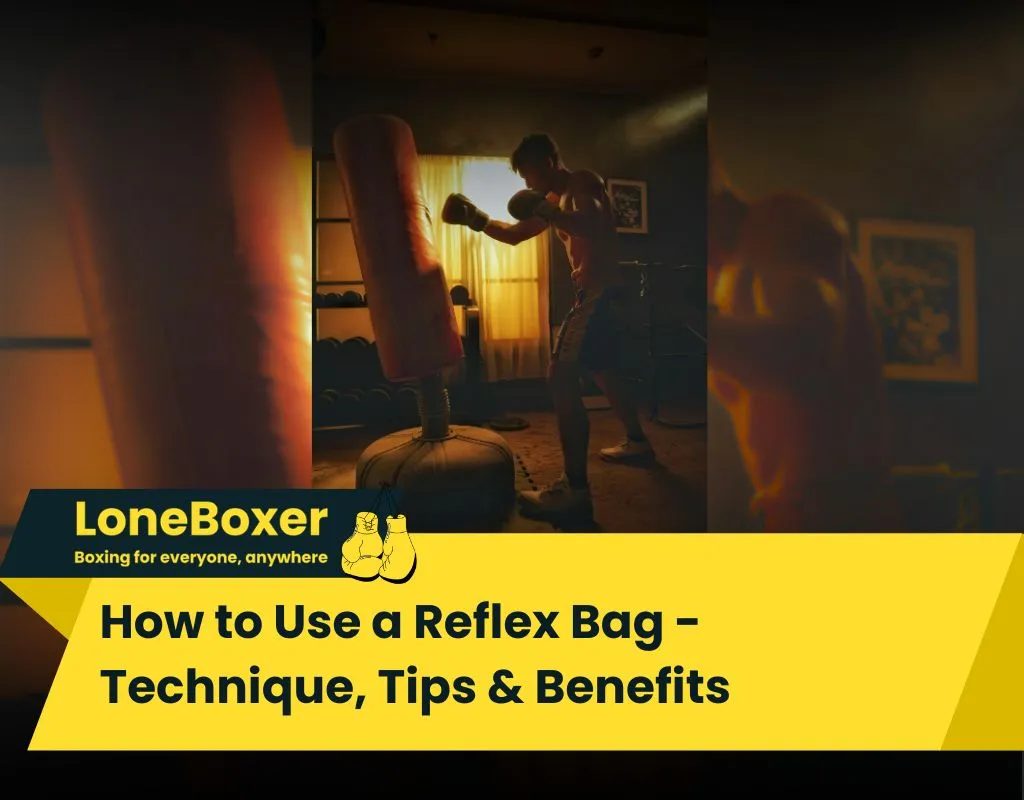
A reflex bag, also known as a cobra bag, is a small freestanding boxing bag mounted on a spring-loaded rod or flexible shaft that rebounds quickly after being struck. Boxers use it to improve timing, accuracy, hand-eye coordination, reaction speed, and defensive awareness by hitting a moving target that returns toward them. Unlike a heavy bag, it is not mainly for power; unlike a speed bag, it is designed to simulate a returning target and sharpen reactive striking.
What’s The Correct Way to Punch a Reflex Bag?
When using a reflex bag in boxing, proper technique is essential for effective training. Stand in a balanced stance with your feet about shoulder-width apart, your rear foot slightly back, and your hands up with your chin tucked. Throw compact, controlled punches at the center of the bag, making clean contact without overhitting or pushing it. Retract your hands quickly after each strike and stay light on your feet so you can react to the bag’s return. Keep the rhythm controlled, adjust your distance to avoid overreaching, and mix in simple defensive movements such as slips or ducks as the bag rebounds. Consistent practice helps improve timing, accuracy, reflexes, and defensive awareness.
Below are some of the points to keep in mind while practicing on a cobra bag.
1. Wrap Your Hands
Wrap your hands properly before using a reflex bag to protect the knuckles, wrists, and small joints in the hands from repeated impact. Good hand wrapping helps stabilize the wrist, add cushioning over the knuckles, and reduce the risk of strain during fast, repetitive punching. Make sure the wraps are snug enough to provide support without cutting off circulation. Using clean, well-fitted wraps consistently helps improve both safety and comfort during training.
2. Get Into a Proper Stance
A proper stance on the reflex bag should keep you balanced, relaxed, and ready to react. Stand with your feet about shoulder-width apart, your rear foot slightly back, knees slightly bent, and weight centered. Keep your hands up, chin tucked, and shoulders relaxed so you can punch and recover quickly without losing position. Stay light on your feet and avoid leaning too far forward or reaching for the bag, since good reflex bag work depends on balance, distance control, and quick reactions to the rebound.
3. Be Aware Of Your Hand Position
Keep your hands in a compact, ready position around cheek to chin level while working the reflex bag. Your elbows should stay close enough to keep your movements controlled, but relaxed enough that your arms can punch and recover smoothly. Good hand position helps you stay balanced, react quickly to the bag’s rebound, and avoid letting your punches become wide or sloppy. Staying relaxed is important, because unnecessary tension can slow your rhythm and reduce your accuracy.
4. Practice Striking
Practice striking the reflex bag with clean, compact punches and controlled technique. Focus on landing straight shots accurately, retracting your hands quickly, and staying balanced as the bag rebounds toward you. Avoid overhitting or pushing the bag, since the goal is to improve timing, control, and reaction speed rather than power. Keep your hands up, breathe steadily, and stay relaxed so your punches remain sharp and your movements fluid. Consistent, focused practice helps build the coordination and rhythm needed to use the reflex bag effectively.
5. Learn Correct Breathing Techniques
Proper breathing helps you stay relaxed and maintain rhythm while working the reflex bag. Breathe in naturally between punches and exhale lightly or sharply as you strike, rather than holding your breath. Good breathing keeps your shoulders and arms from tightening up too quickly, which helps you stay accurate and react smoothly to the bag’s rebound. Over time, steady breathing improves endurance and makes reflex bag work feel more controlled and efficient.
6. Throw Combinations
Throwing combinations on a reflex bag helps improve timing, hand speed, rhythm, and the ability to recover quickly between punches. Start with simple combinations such as the jab-cross, then add hooks or body shots as your control improves. Keep the punches compact and accurate, and stay balanced so you can react to the bag’s return after each strike. The goal is not to hit as hard as possible, but to string punches together smoothly while maintaining control, timing, and defensive awareness.
7. Add Footwork And Defense Movements
Adding footwork and defensive movements to reflex bag training makes the drill more realistic and improves overall ring coordination. Stay light on your feet, keep your knees slightly bent, and make small adjustments in position so you can stay at the right distance as the bag rebounds. Mix in simple defensive actions such as slips, ducks, or small-angle changes after punching to build better timing and reaction habits. Practicing these movements with the reflex bag helps you stay balanced, recover quickly, and respond more naturally to a moving target.
What Punching Combinations to Use on the Reflex Bag?
Beginners should start with short, simple combinations on the reflex bag to build timing, accuracy, and control. As they improve, they can add more varied combinations, including hooks, uppercuts, or body shots, as long as they stay balanced and ready to react to the bag’s return. The best combinations for reflex bag work are compact and controlled, helping boxers sharpen rhythm, hand speed, and defensive recovery.
- Jab-Cross: a simple and effective combination for building rhythm and straight punching accuracy.
- Jab-Cross-Left Hook: Begin with a jab, follow with a cross, and finish with a left hook.
- Jab-Left Hook-Cross: Start with a jab, throw a left hook, and finish with a cross.
- Jab-Left Hook-Jab: Execute a jab, follow with a left hook, and finish with another jab.
- Jab-Cross-Jab: Start with a jab, follow with a cross, and finish with another jab.
- Cross-Jab-Left Hook: Begin with a cross, follow with a jab, and finish with a left hook.
What’s the Correct Height for a Reflex Bag?
The correct height for a reflex bag is usually set so the striking area is around chin level for the user. This allows the boxer to punch with natural mechanics, keep the hands in a proper position, and react comfortably to the bag’s rebound. Since height varies from person to person, most reflex bags are adjustable, but the ideal setup is the one that lets you strike cleanly without reaching up or punching down awkwardly.
What are the Benefits of Using a Reflex Bag?
Reflex bags help improve hand-eye coordination, timing, reaction speed, and punching accuracy by forcing boxers to hit a moving target that quickly returns toward them. They are especially useful for sharpening rhythm, defensive awareness, and the ability to recover quickly after each punch. Reflex bag training can also support conditioning and upper-body endurance during longer rounds. In addition, reflex bags are convenient for home training because they are compact, adjustable, and easier to set up in smaller spaces than many other boxing bags.
Is Hitting a Reflex Bag a Good Workout?
Hitting a reflex bag is a good workout because it improves coordination, reaction speed, timing, and overall conditioning. It keeps the hands active, raises the heart rate, and helps build endurance while training a boxer to react to a moving target. Although it is not a complete workout on its own, reflex bag training can be a very effective part of a broader boxing or fitness routine.
How to Use a Reflex Bag for Weight Loss?
Reflex bag training can support weight loss when used as part of a broader boxing or interval-based workout. Short, fast rounds on the bag can raise heart rate, improve conditioning, and help burn calories, especially when combined with other exercises such as skipping, bag work, or strength training. Consistency matters, but so does overall calorie balance, so reflex bag sessions work best when paired with regular training and a diet that supports fat loss.
What are Other Types of Boxing Bags?
Heavy bags build power and endurance; they are durable, cylindrical, and designed for hard-hitting workouts. Speed bags develop rhythm, timing, and hand-eye coordination; they are small, air-filled, and rebound quickly. Double-end bags improve accuracy and timing; they are anchored at both ends and move unpredictably. Maize bags are used to sharpen head movement, slipping, and weaving; they are usually teardrop-shaped and swing back and forth. Uppercut bags refine uppercuts and close-range body punching by providing angles that suit inside punching techniques.
1. Heavy Bag
The heavy bag is the most common and versatile type of boxing bag. It is typically cylindrical and filled with materials such as sand, cloth, or water to provide resistance. The proper way to use the heavy bag is to practice punching technique, power, combinations, and endurance with controlled, purposeful strikes. It helps boxers build stronger punches, improve movement around a target, and develop overall conditioning.
2. Speed Bag
The speed bag is a small, air-filled bag that hangs from a platform by a swivel and rebounds quickly after being struck. Learning to use speed bag techniques helps boxers improve hand-eye coordination, rhythm, timing, and shoulder endurance through quick, controlled, repetitive strikes. It is especially useful for developing smooth punching flow, consistent tempo, and better overall coordination.
What’s the Difference Between a Reflex Bag and a Speed Bag?
A reflex bag has a freestanding design and rebounds unpredictably, helping a boxer improve reaction time, defensive awareness, timing, and the ability to hit a moving target. A speed bag, by contrast, is mounted under a rebound platform and moves in a steady rhythm, helping develop hand-eye coordination, timing, rhythm, and shoulder endurance.